Buying an LED display sample before a bulk order sounds like a simple extra step. In practice, it can save you from discovering expensive problems after dozens of cabinets have already been produced.
The key is knowing what the sample is supposed to prove. A bright picture in a short video is not enough. You need to check whether the sample matches your real project, whether its parts are suitable for long-term use, and whether the factory can reproduce the same quality in mass production.
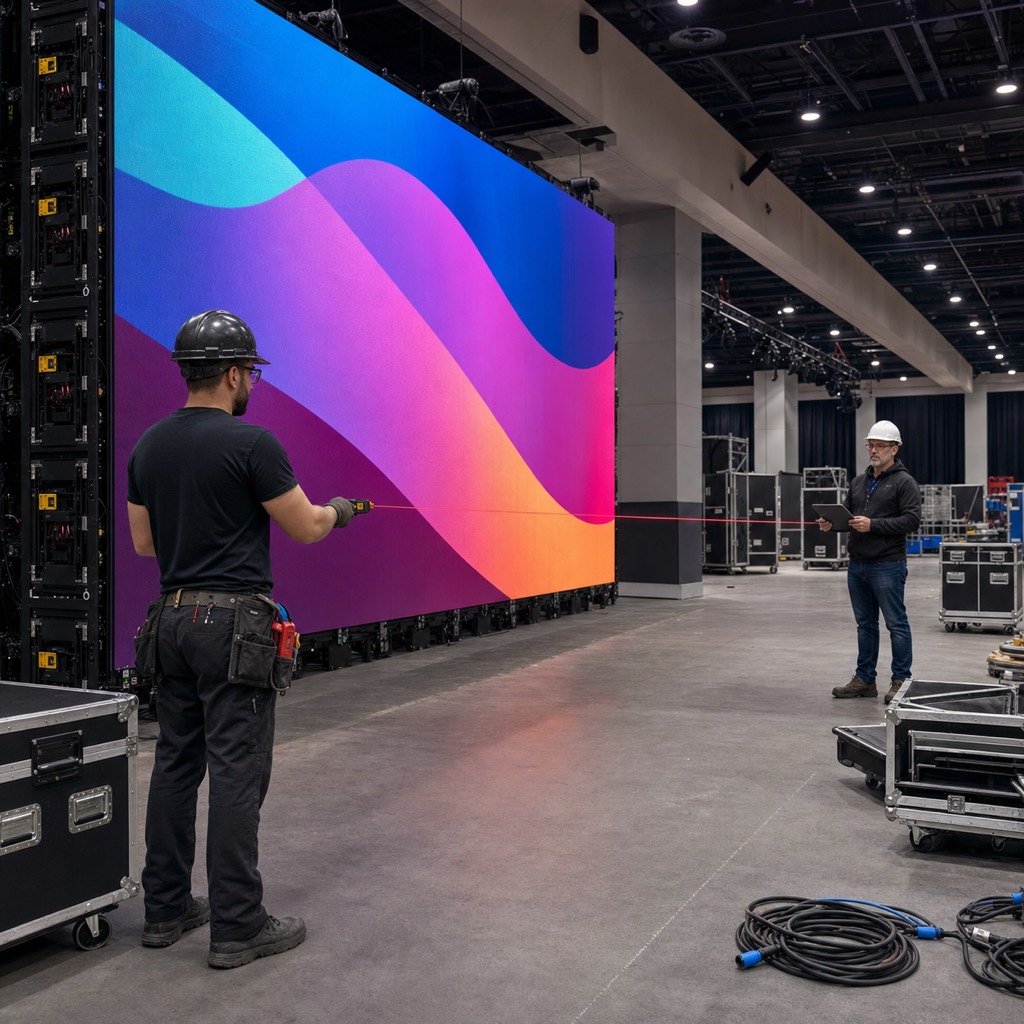
Should you order an LED display sample first?
For a standard project with a trusted supplier, a sample may not always be necessary. But it is a smart move when you are working with a new factory, ordering a custom cabinet, comparing two suppliers, or preparing a larger rollout across several locations.
A sample is especially useful when your customer has strict requirements for color, cabinet appearance, installation method, control system, or service access. It gives everyone something physical to approve before the bulk order begins.
1. Make sure the sample matches the final specification
Start with the basics. Ask the supplier to list the exact parts used in the sample: LED type, driver IC, power supply, receiving card, module size, cabinet material, brightness, refresh rate, scan mode, and protection level where relevant.
Then compare that list with the quotation and purchase order. This sounds obvious, but samples are sometimes assembled from available parts just to demonstrate appearance. If the bulk production will use different components, the sample cannot be treated as a true production reference.
For an outdoor LED display, also confirm waterproofing, cabinet sealing, drainage design, and corrosion resistance. For an indoor LED display, pay closer attention to viewing distance, grayscale performance, noise, and front-service access.
2. Test the module at different brightness levels
Do not judge the sample only at 100% brightness. Run it at low, medium, and high brightness with white, red, green, blue, gray, and black test images. A screen can look fine at full brightness but show uneven grayscale, color blocks, or flicker when dimmed.
If the display will be filmed, test it with a phone and a professional camera if possible. Look for scan lines and flicker at the frame rates your customer normally uses. Refresh rate matters, but the actual camera result is more useful than a number on a specification sheet.
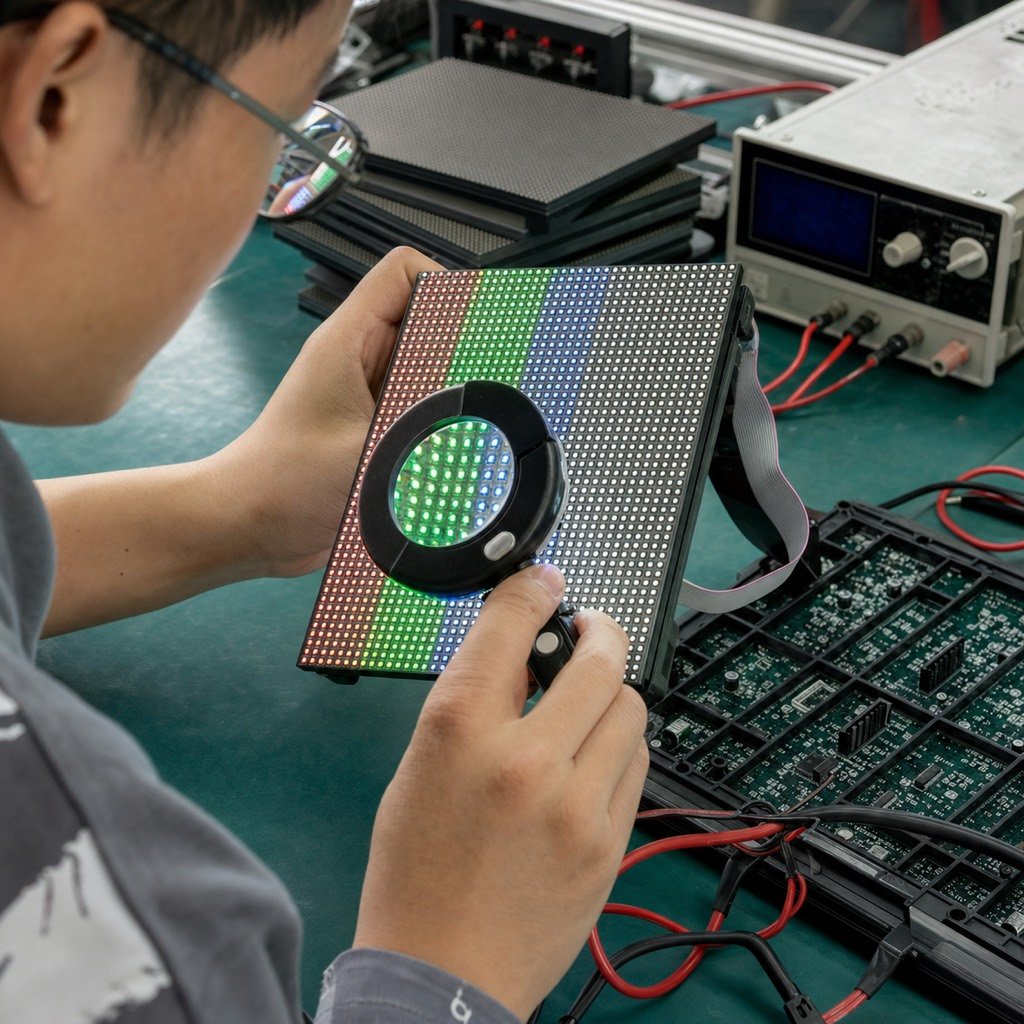
3. Check dead pixels, color uniformity, and module seams
View the sample from the front, from both sides, and at the expected viewing distance. Check for dead or permanently bright pixels, uneven color, visible module borders, shadows between modules, and brightness differences.
For a fine-pitch screen, inspect the flatness carefully. Even a small height difference between modules can create dark or bright lines. For a rental cabinet, connect several cabinets together and check whether the locks align and the seams stay consistent.
4. Inspect the cabinet, connectors, and service access
Picture quality gets most of the attention, but installers spend their time handling the cabinet. Lift it, lock it, connect power and data, remove a module, and open the rear cover if the design allows it.
Ask practical questions: Are the handles comfortable? Are the corners protected? Can one technician replace a module? Are cables easy to identify? Do the locks feel solid after repeated use? These details have a direct impact on installation time and maintenance cost.
If your project is mobile or event-based, compare the sample with the requirements in our rental LED display range. Weight, locking speed, corner protection, and flight-case layout matter just as much as brightness.
5. Run an aging test
A ten-minute demonstration does not tell you how the screen behaves after it gets warm. Ask the factory to run the sample continuously and cycle through test patterns. During the aging test, check temperature, fan noise, power stability, color drift, and intermittent pixel faults.
You do not need to stand beside the sample for the entire test. The supplier can provide time-stamped photos or short videos from the start, middle, and end. What matters is having a clear record and checking any issue before approval.
6. Test the control system with your real content
Send the supplier a few real videos, logos, presentations, or camera feeds from your project. This quickly reveals whether the aspect ratio, resolution, scaling, color, and playback method work as expected.
Also confirm the sending device, receiving-card configuration, backup files, and software version. Ask for the final configuration file. Keeping that file with the project documentation can save a lot of time during installation or future service.
7. Confirm accessories and spare parts
The sample review is a good time to finalize the complete delivery list. Check power cables, data cables, spare modules, receiving cards, power supplies, tools, mounting parts, flight cases, and any custom accessories.
Make sure connector types and plug standards match the destination country. A small mismatch can stop an installation even when the LED cabinets themselves are perfect.
8. Lock the approved sample into the bulk order
This is the step buyers often miss. Once the sample is approved, record the final specification, take clear photos, and state in the purchase order that bulk production must match the approved sample.
Ask the factory to keep the approved sample as a reference until production and pre-shipment inspection are complete. During final inspection, compare a random production cabinet with that reference for appearance, components, brightness, color, and assembly.
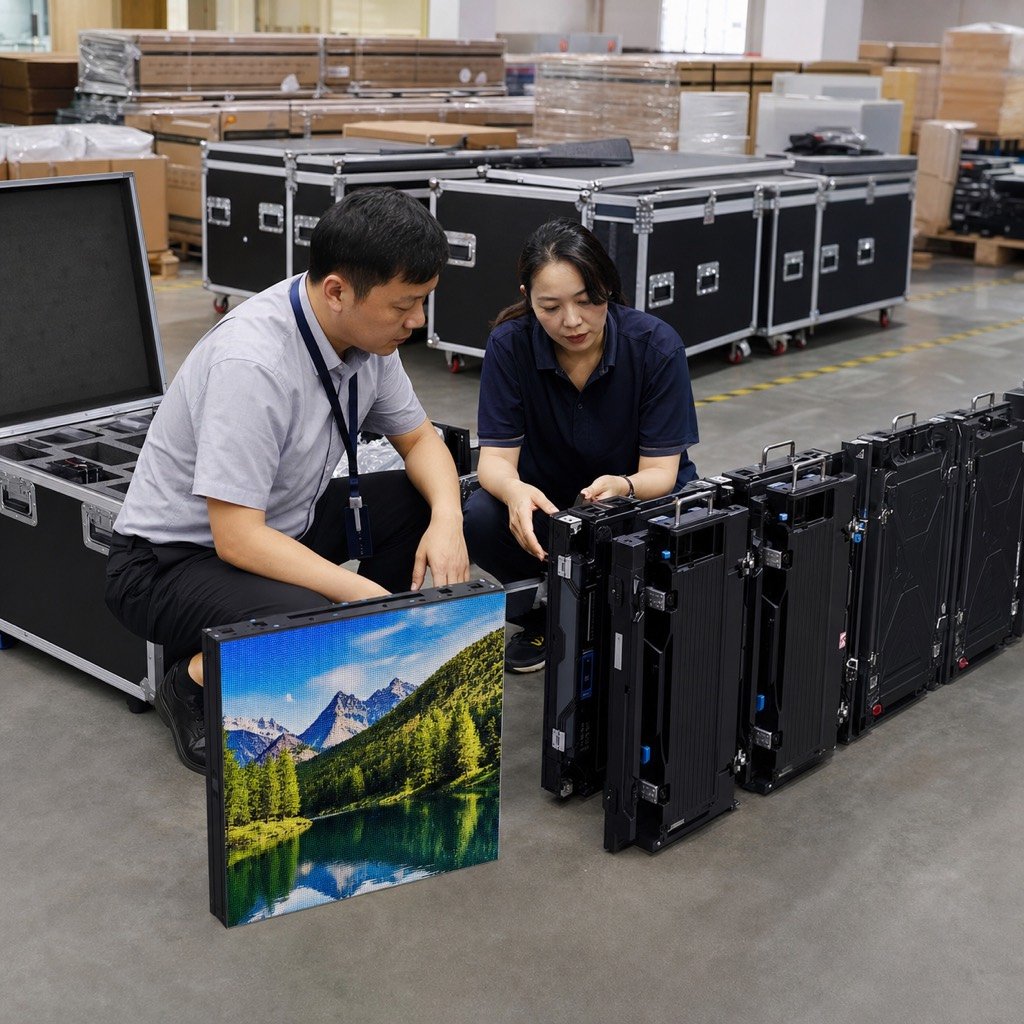
A simple sample approval checklist
- All components match the quotation and final order.
- Brightness, refresh rate, color, and grayscale suit the application.
- No dead pixels, obvious seams, or uneven modules are visible.
- Cabinet locks, handles, connectors, and service access work smoothly.
- The sample passes an aging test without unstable faults.
- Real project content plays correctly through the control system.
- Accessories, spares, plugs, and packaging are confirmed.
- Bulk production is documented to match the approved sample.
FAQ
How much does an LED display sample cost?
The cost depends on pixel pitch, cabinet type, size, and whether the design is customized. Some suppliers charge the normal unit price plus shipping, while others may credit part of the sample cost after a bulk order. Confirm this before payment.
Can a single module be used as a sample?
A module is useful for checking LEDs, color, and basic image performance. It cannot fully prove cabinet flatness, locks, structural strength, wiring, waterproofing, or multi-cabinet seams. For a serious project, a complete cabinet is usually a better reference.
How long should sample testing take?
Basic inspection can be completed in a day, but an aging test should run long enough to reveal heat-related or intermittent issues. The exact time depends on the product and project risk. Ask for a documented test plan rather than relying on a fixed number alone.
What if the sample needs changes?
Write down each change, ask for updated photos or videos, and revise the specification before approving production. Do not leave changes in chat messages only. They should appear in the final quotation, drawing, or purchase order.
Can Mirun Hailian provide sample testing records?
Yes. Depending on the project, we can discuss sample configuration, test content, aging-test records, component details, and pre-shipment checks before bulk production.
Final thought
An LED display sample is not just a smaller order. It is your chance to turn a quotation into something measurable. Test it like the real project, document the approved result, and use it as the standard for bulk production.
Planning a new LED display project? Send us your application, screen size, viewing distance, installation environment, and target delivery date. We will help you decide whether a module sample, a full cabinet, or a factory test is the most useful next step.
Need help choosing the right LED display?
Tell us your installation scene, screen size, pixel pitch target and timeline. Mirun Hailian can help match the right product configuration.