An LED floor project can look straightforward on a drawing and still run into expensive problems on site. Uneven flooring, an unapproved finished height, a blocked cable path, or an undefined traffic route can force last-minute changes after the cabinets arrive. This LED floor display site readiness checklist helps B2B buyers collect the right information before requesting a final configuration or approving production.
Start with the floor plan, not the display specification
Before comparing cabinet or pixel-pitch options, define exactly where the display will sit and how people will use the surrounding space. A useful site drawing should show the screen footprint, nearby walls and doors, emergency routes, audience approach, backstage access, control position, and the path used to move equipment into the venue.
Record dimensions from the real venue rather than relying only on an early architectural plan. Temporary stages, floor boxes, columns, carpet transitions, door swings, and venue barriers can reduce the usable area. If the display is part of a touring event, document the smallest venue and the most restrictive loading route, not just the ideal location.
Confirm LED floor display height and edge transition
For an LED floor display, the visible surface is only one part of the installed height. The cabinet, support system, leveling allowance, cable space, and any protective layer all affect the final elevation. Ask the supplier to show the proposed build-up and have the venue or project team approve it before production.
Also decide how users will step onto or walk around the display. A flush transition, a ramp, or a protected perimeter can each be appropriate in a different project. The right choice depends on venue rules, accessibility requirements, expected traffic, cleaning procedures, and whether carts or equipment will cross the area. Do not leave this edge detail for the installation crew to improvise.
For projects in the United States, the site safety review should also check applicable OSHA walking-working-surface requirements. Projects in other countries should use the equivalent local rules and the venue’s own requirements.
Verify floor condition and project loading
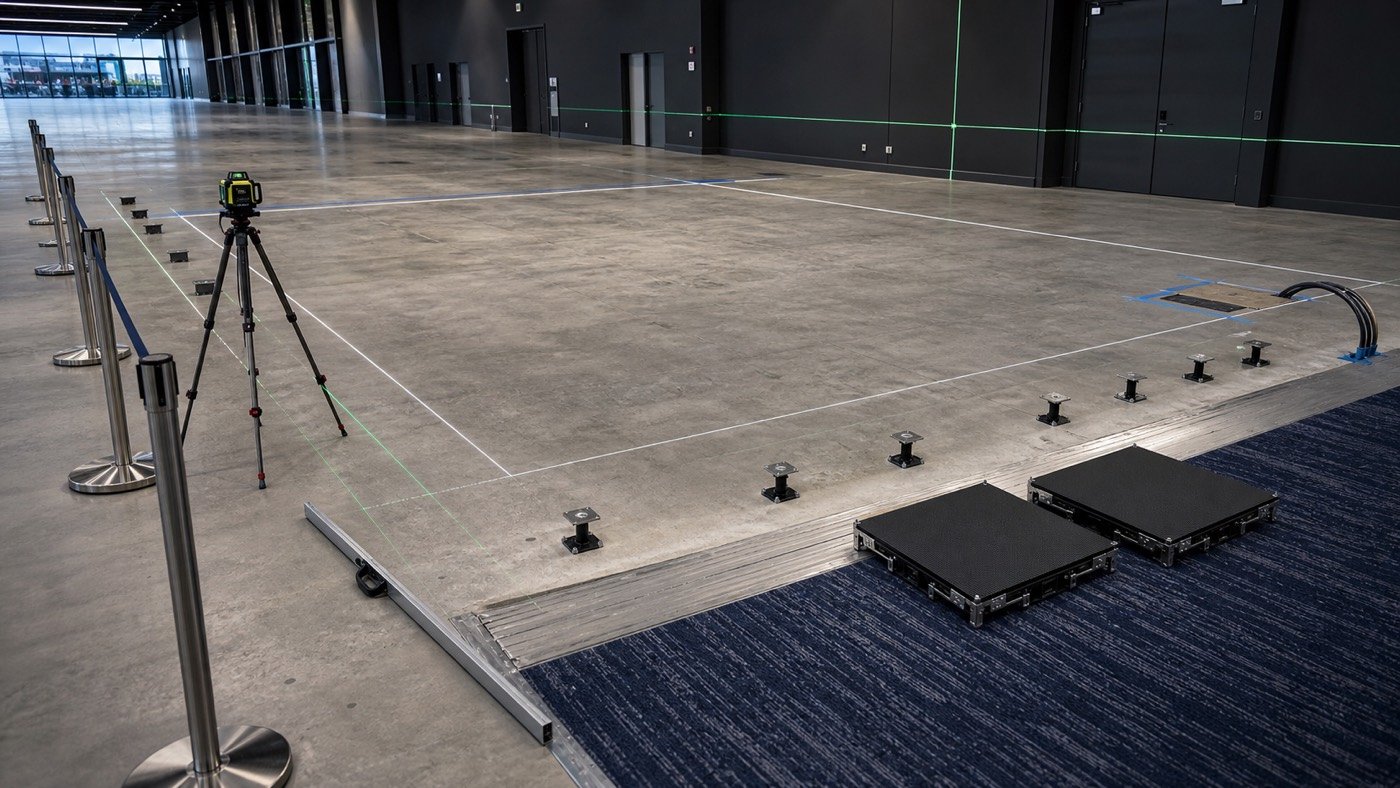
Check the subfloor for level variation, cracks, movement, moisture, soft finishes, and floor boxes inside the proposed footprint. A site survey should identify where adjustment is possible and where the base must be repaired or protected. For a temporary installation, confirm whether tape, anchors, protective mats, or other floor-contact methods are allowed by the venue.
Loading approval is a project decision, not a marketing claim. Tell the supplier what will travel over the display: pedestrian traffic, performers, staging equipment, carts, or other planned loads. Then have the responsible venue, structural, or safety professional verify the complete installed system for that use. The RFQ should distinguish normal use from unusual point loads or moving equipment.
Map LED floor display power, signal and cable access
Mark the location of available electrical distribution and identify who is responsible for the final power design. The supplier needs the project voltage, frequency, distribution approach, permitted cable routes, and any venue restrictions. The project electrician or other qualified party should approve the installed electrical system.
Signal planning matters just as much. Show the control position, maximum practical cable route, content source, backup expectations, and network restrictions. Decide whether cables enter from below, from an edge, or through a protected bridge. Keep maintenance access in mind: a clean drawing should explain how a failed component can be reached without dismantling unrelated venue structures.
If the project is temporary, compare the workflow with a rental LED display setup. If it will operate in a permanent indoor space, review the wider system context on the indoor LED display page. The installation method and service plan should match the actual operating model.
Define traffic, content and operating responsibility
Describe who will use the floor and when. A trade-show photo area, a performance surface, and an interactive visitor zone have different traffic patterns and operating risks. Note footwear, rolling cases, cleaning equipment, crowd direction, supervised hours, and any periods when the display must be covered or isolated.
Content responsibility should also be assigned before handover. Confirm the input format, content resolution, playback operator, approval process, and what happens if the interactive feature is unavailable. A visually impressive floor still needs a simple operating plan. Review relevant installation examples in Project Cases, but treat each new venue as its own engineering and operational decision.
LED floor display site readiness RFQ fields
| RFQ field | What the buyer should provide | Why it matters |
|---|---|---|
| Active display size | Exact width and depth, plus a marked site plan | Defines cabinet layout and surrounding clearance |
| Venue and installation type | Permanent, single event, or touring use | Shapes the support, protection and service approach |
| Finished-height limit | Approved elevation and edge-transition requirement | Prevents ramp, access and nearby-floor conflicts |
| Floor condition | Surface type, level survey, floor boxes and restrictions | Identifies leveling and protection needs |
| Planned traffic and loads | People, carts, props or equipment expected on the surface | Supports project-specific safety review |
| Power and signal | Voltage, distribution point, control position and cable route | Reduces late electrical and routing changes |
| Content and interaction | Source, format, operator and desired user behavior | Clarifies the playback and control workflow |
| Service access | Allowed access direction, working space and response plan | Makes maintenance practical after handover |
| Schedule | Required installation, testing and opening dates | Allows realistic production and site coordination |
You can compare the broader product families in the Products Catalog and review the available floor-display configuration context on the LED floor display page. Use those pages to prepare questions, then base the final selection on the verified site information.
Pre-installation approval checklist
- Latest site dimensions and screen orientation are signed off.
- Finished height and perimeter treatment are approved.
- Subfloor condition and permitted fixing methods are documented.
- Planned traffic and loads have been reviewed by the responsible project party.
- Power distribution and cable routes have named owners.
- Control location, content source and backup expectations are agreed.
- Installation route, storage area and working hours are confirmed.
- Service access and spare-parts handling are defined.
- Testing, operator training and acceptance responsibilities are assigned.
- The final quote lists assumptions and exclusions that the buyer can verify.
Turn the site survey into a quote-ready brief
A good LED floor display RFQ is not a long list of product buzzwords. It is a short, evidence-based description of the venue, use, constraints, responsibilities, and approval process. That information helps the supplier propose a configuration that can actually be installed and operated as planned.
Send the marked floor plan, site photos, required dates, traffic description, finished-height limit, and power/control details through the Mirun contact form. Ask for any assumptions to be listed clearly in the quotation so your technical, venue, and procurement teams can review the same scope.
Need help choosing the right LED display?
Tell us your installation scene, screen size, pixel pitch target and timeline. Mirun Hailian can help match the right product configuration.