
If you are buying an LED display for a business project, the fastest way to get a useful quote is not just asking, “How much per square meter?”
That question is normal, of course. Everyone has a budget. But for a real B2B LED display project, the square-meter price is only one small part of the story. A supplier also needs to know where the screen will be used, how far people will stand from it, how it will be installed, what content it will show, and who will maintain it later.
So in this guide, let us keep it practical. Here is the project brief I would send before asking for an LED display quote. You do not need to write a long technical document. Just send the right details, and your quotation will be much more accurate.
Quick answer: what should a B2B buyer send first?
For a faster and cleaner LED display quote, send these details at the beginning:
- Application: retail, outdoor advertising, event rental, lobby, control room, showroom, venue, or another use case
- Screen size: width and height, or the available installation area
- Indoor or outdoor environment
- Expected viewing distance
- Installation method: wall-mounted, hanging, ground-supported, fixed structure, or rental frame
- Maintenance access: front service, rear service, or not sure yet
- Content type: videos, ads, live camera, text, dashboards, presentations, or mixed media
- Target delivery date and destination country
- Any photos, drawings, or site measurements you already have
That is already enough for a supplier to recommend a starting configuration. Now let us go through each part in plain English.
1. Start with the real application, not the product name
Many buyers start by saying, “I need a P2.5 screen” or “Please quote indoor LED.” That is fine, but it does not tell the full story.
A P2.5 indoor LED display for a corporate lobby is not always the same as a P2.5 screen for a retail store, a church, a meeting room, or a broadcast background. The screen may need different brightness, refresh rate, cabinet design, installation method, and color performance.
A better first line sounds like this:
We are planning an indoor LED video wall for a retail showroom. The screen will show product videos and brand visuals. People will stand around 2 to 5 meters away.
That gives the supplier much more to work with. If you already know the product type, you can still mention it. Just do not let the model name replace the use case.
2. Give the screen size, even if it is only approximate
LED display pricing depends heavily on the final size. But size also affects resolution, cabinet quantity, structure, power, packing, and installation planning.
If you have the exact size, send it like this:
- Width: 6 meters
- Height: 3 meters
- Installation area: flat wall, indoor showroom
If you do not have the final size yet, send the available wall or structure size. A good supplier can help adjust the screen dimensions to match standard cabinet sizes, which often saves cost and makes installation cleaner.
One small tip: photos are useful, but measurements are better. A photo can show the environment. A measurement tells the supplier what can actually fit.
3. Tell the supplier the viewing distance
Pixel pitch is one of the most common questions in LED display buying. Smaller pixel pitch can show more detail, but it also costs more. Bigger pitch is cheaper, but it may not look clean if people stand too close.
That is why viewing distance matters so much. A screen for close viewing in a meeting room or showroom may need a fine pitch LED display. A screen for outdoor advertising may not need such a small pitch because people view it from farther away.
You do not need to calculate everything perfectly. Just tell the supplier the closest and typical viewing distance. For example:
- Closest viewing distance: around 2 meters
- Typical viewing distance: 4 to 8 meters
- Far viewing distance: up to 20 meters
With that information, the supplier can suggest a pixel pitch that balances image quality and budget.
4. Indoor and outdoor projects need different checks
An indoor LED display and an outdoor LED display may look similar in a catalog, but they are built for very different conditions.
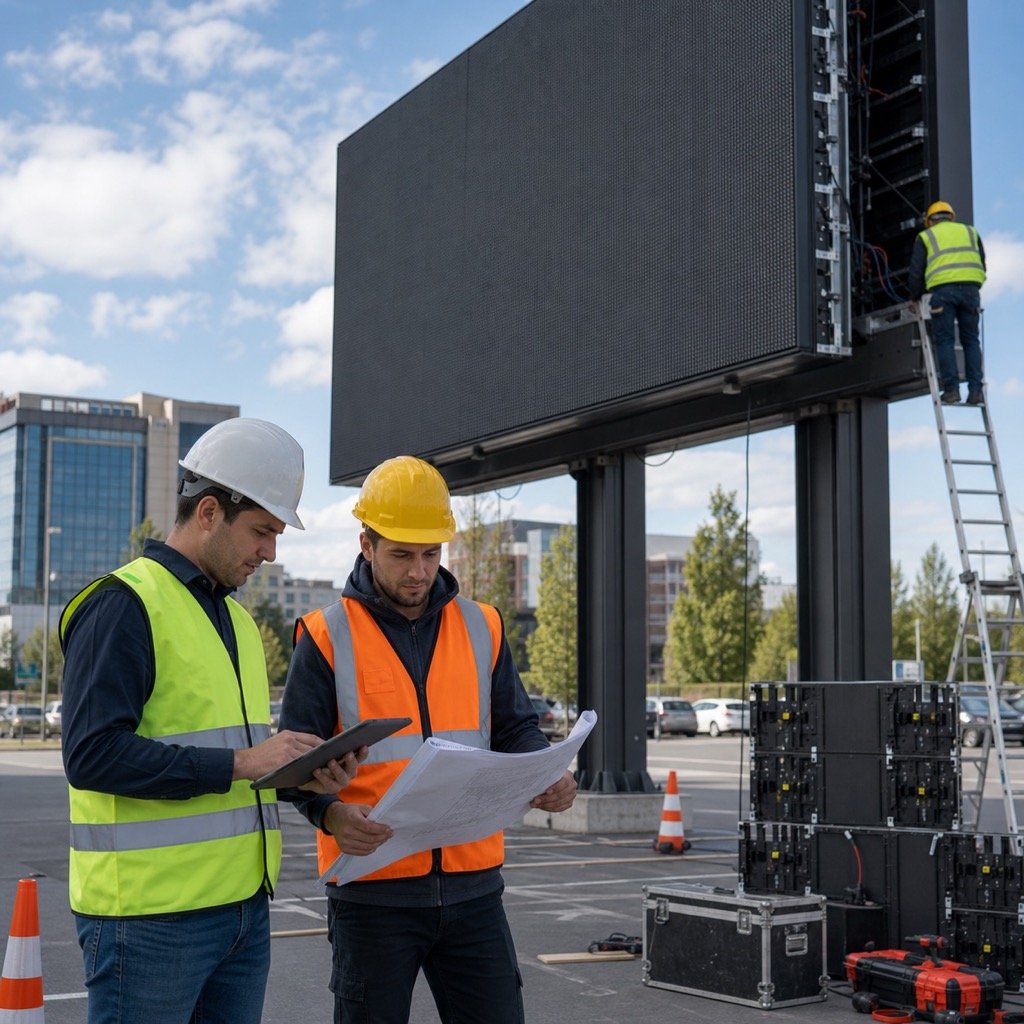
For indoor projects, the big questions are usually viewing comfort, resolution, cabinet flatness, front maintenance, heat control, and clean installation.
For outdoor projects, the checklist gets longer. You need to think about brightness, IP rating, sunlight, rain, dust, wind load, steel structure, power distribution, ventilation, and service access.
If the screen is outdoor, send site photos from several angles. If there is an existing structure, send the drawing or at least the rough dimensions. This helps the supplier avoid guessing.
5. Explain how the screen will be installed
Installation method can change the cabinet choice and the whole quotation.
For a fixed wall-mounted screen, front maintenance may be important because technicians may not have space behind the screen. For an outdoor billboard, rear service may be easier if there is a service platform. For rental events, lightweight cabinets, fast locks, and flight cases may matter more than cabinet thickness.
When sending your brief, mention the installation plan if you know it:
- Fixed installation on wall
- Hanging from truss
- Ground-supported structure
- Outdoor pole or steel frame
- Rental stage system
- Curved, corner, transparent, or custom creative structure
If you are not sure, say so. A clear “not sure yet” is better than a wrong assumption.
6. Share what content the screen will show
This part is easy to forget, but it matters.
If the LED display will show detailed text, dashboards, product close-ups, or presentation slides, resolution and pixel pitch become more important. If the screen mainly shows brand videos, animations, or outdoor ads, brightness, contrast, color, and viewing distance may be more important.
If the screen will be filmed by cameras, such as in a studio, stage, church, conference room, or live event, refresh rate and scan performance should be checked carefully.
A supplier does not need your final video files at the first quote stage. But they do need to know the general content type. That single detail can prevent a lot of wrong recommendations.
7. Ask what is included in the quote
Two LED display quotes can look similar at first glance, but one may include more of what you actually need.
Before comparing price, check whether the quotation includes:
- LED cabinets and modules
- Receiving cards and sending equipment
- Power supplies, cables, and accessories
- Spare modules, spare power supplies, and spare receiving cards
- Control system recommendation
- Structure suggestion or drawing support
- Packing method, usually plywood case or flight case
- Lead time and testing process
- Warranty and remote technical support
If one price is much lower, do not reject it immediately. Just ask what is included and what is not included. Sometimes the cheaper quote is a smart configuration. Sometimes it is missing important parts.
8. Factory testing is not a small detail
For B2B buyers, especially overseas buyers, factory testing is a big part of reducing risk. You want to know the screen is tested before it leaves the factory, not after it arrives at your site.
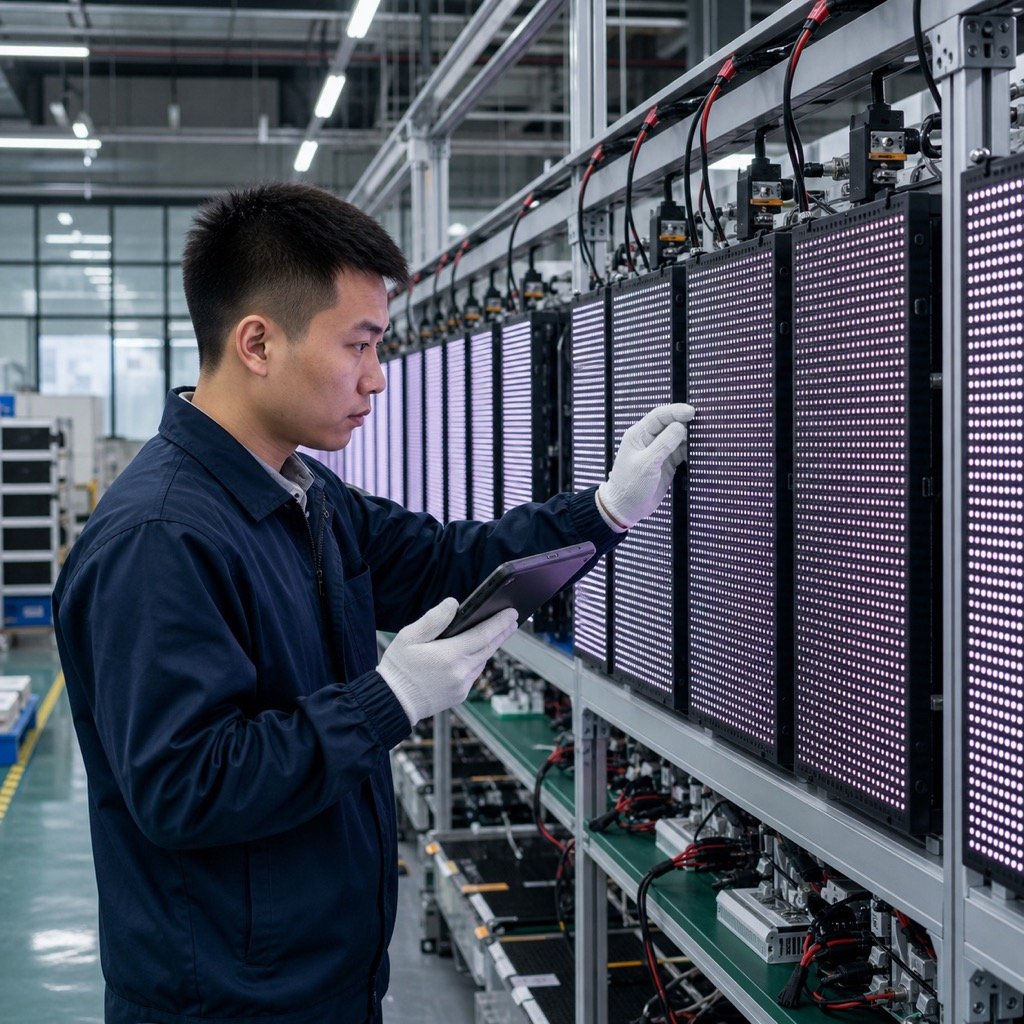
Ask the supplier about aging test, brightness and color checks, module flatness, cabinet assembly, and whether they can send photos or videos before shipping.
This does not need to sound formal. You can simply ask:
Before shipment, can you share testing photos or videos of our LED display after assembly?
That question tells you a lot about how the supplier manages quality.
A simple LED display project brief template
You can copy this structure when sending your inquiry:
| Item | What to send |
|---|---|
| Application | Retail store, outdoor billboard, event stage, lobby, showroom, control room, etc. |
| Screen size | Width, height, or available installation area |
| Environment | Indoor, outdoor, semi-outdoor, high brightness area, or special weather conditions |
| Viewing distance | Closest and typical viewing distance |
| Installation | Wall, truss, steel structure, rental frame, ground support, or not sure yet |
| Content | Videos, ads, dashboards, text, live camera, presentations, or mixed content |
| Timeline | Expected delivery date, event date, or installation window |
| Destination | Country, city, port, or delivery address if available |
Common mistakes that slow down a quote
Here are a few things that often make LED display quoting slower:
- Only asking for a price list without project details
- Choosing pixel pitch before confirming viewing distance
- Forgetting to mention indoor or outdoor environment
- Comparing quotes without checking what accessories are included
- Not sending photos or dimensions of the installation site
- Ignoring maintenance access until installation day
None of these mistakes are unusual. Most buyers are not LED engineers, and they do not need to be. The point is simply to give the supplier enough context to recommend the right screen.
FAQ
Do I need to know the exact pixel pitch before asking for a quote?
No. If you know the viewing distance, screen size, and application, a supplier can recommend a suitable pixel pitch. You can still ask for two options if you want to compare budget and image quality.
Can I ask for a quote if I only have a rough idea?
Yes. Just say it is an early-stage project. Send the approximate size, use case, country, and timeline. A rough quote can help you plan the budget before final drawings are ready.
What is the most important detail for an outdoor LED display?
There is no single detail, but brightness, IP rating, structure, wind load, power, and service access are all important. Outdoor projects need more site information than indoor projects.
Why do two suppliers recommend different pixel pitches?
They may be making different assumptions about viewing distance, budget, image quality, and cabinet size. Ask each supplier why they recommend that pitch. The explanation is often more useful than the number itself.
How can I get a faster quote from Mirun Hailian?
Send your screen size, application, indoor or outdoor environment, viewing distance, installation photos, and target delivery date through our contact page. We can then suggest a practical LED display configuration and quotation checklist.
Final thought
A good LED display quote is not just a price. It is a project plan in a simple form. The more clearly you describe the project, the easier it is for the supplier to recommend the right LED display, avoid missing parts, and keep the order moving smoothly.
If you are planning a project, you can also compare related options such as indoor LED display, outdoor LED display, rental LED display, and fine pitch LED display before sending your brief.
Need help choosing the right LED display?
Tell us your installation scene, screen size, pixel pitch target and timeline. Mirun Hailian can help match the right product configuration.