An LED wall can show a clean picture during a factory video and still leave an important purchasing question unanswered: does the electromagnetic compatibility evidence describe the equipment you will actually receive? A report for one cabinet, a different power supply or a shorter cable arrangement may not explain the proposed installation.
Review LED display EMC reports as configuration evidence, not as a logo collection. Start with the identified product, the intended environment, the tests covered, the operating arrangement and the conditions attached to the result. Then ask who will review differences between that arrangement and your order. This guide is a procurement checklist, not a compliance determination for a specific product or country.
What does an EMC report answer?
Electromagnetic compatibility has two sides. Emissions concern disturbance from the equipment; immunity concerns how equipment behaves when disturbance is applied. A good-looking screen image answers neither question on its own.
The European Commission’s EMC Directive overview explains that the framework addresses both emissions and immunity. Its scope also includes apparatus and fixed installations. For an EU project, ask the responsible compliance specialist how the supplied equipment and the completed installation are being assessed. Do not assume a cabinet document settles every site obligation.
The practical purchase decision is broader than “has EMC.” You need to know what the evidence covers and which operating conditions must be preserved. This matters for an indoor LED display as well as an outdoor installation: nearby electronics, the control equipment and the final wiring all belong in the project discussion.
Begin with the report’s identity, not its cover image
Ask for the complete relevant report, including its annexes and configuration photographs, rather than a cropped pass page. Record the report number, revision, issuing laboratory, applicant, manufacturer and tested model. Check whether the names and product identifiers can be connected to the quotation.
A commercial series name is not always enough. Request an explanation of which cabinet versions, modules, power supplies and control options belong to the tested configuration. If the offered model is not named, ask for the technical basis linking it to the evidence. An explanation is more useful than a salesperson simply saying that the cabinets are similar.
This is a document review, not an accusation. Confidential schematics may require a controlled exchange with the buyer’s technical reviewer. Agree what purchasing needs to retain and what can be reviewed under confidentiality. A certificate thumbnail should not be the only evidence available to the people responsible for approval.
Separate emission coverage from immunity coverage
Read the test scope line by line. IEC’s public description of CISPR 32 concerns multimedia-equipment emissions and identifies Class A and Class B. Its description of CISPR 35 concerns multimedia-equipment immunity. These are examples of distinct scopes, not a universal standards list for every LED project.
Ask the laboratory or compliance reviewer to identify the applicable standards, editions, amendments, environment and equipment classification. A familiar standard number without its date or scope is an incomplete answer. Do not select an emission class as if it were a premium-versus-budget product grade.
Also distinguish a report that records one investigation from a report addressing the agreed assessment scope. An engineering pre-scan can help development without being the final evidence your purchase specification requires. Record the role of each document instead of comparing every PDF as if it performed the same job.
Reconstruct the operating configuration
The report should let your technical reviewer understand what was connected and how it was operated. Useful review fields include the cabinet arrangement, control equipment, power supply, exposed ports, cable assemblies, operating mode and configuration photographs. These are procurement fields to request; their required form depends on the assessment method.
For EU apparatus, Annex II of Directive 2014/30/EU, consolidated text addresses normal intended operating conditions and representative configurations in the EMC assessment. It also places test reports within the technical documentation. That is why a report and a product’s conformity documentation should not be treated as interchangeable documents.
Do not invent your own “worst case” by insisting that a white image or maximum brightness always represents every relevant test. Ask how the chosen operating modes were justified. Where multiple modes were reviewed, keep the association between each mode, configuration and result. A video showing normal content is not a substitute for that explanation.
Which cable details should stay controlled?
Cable drawings are easy to separate from the EMC paperwork during purchasing. Bring them back together. Ask whether the reported arrangement used the same external cable types, lengths, connector assemblies and accessories as the proposed order. Where the instructions call for a specific treatment or installation condition, identify it clearly.
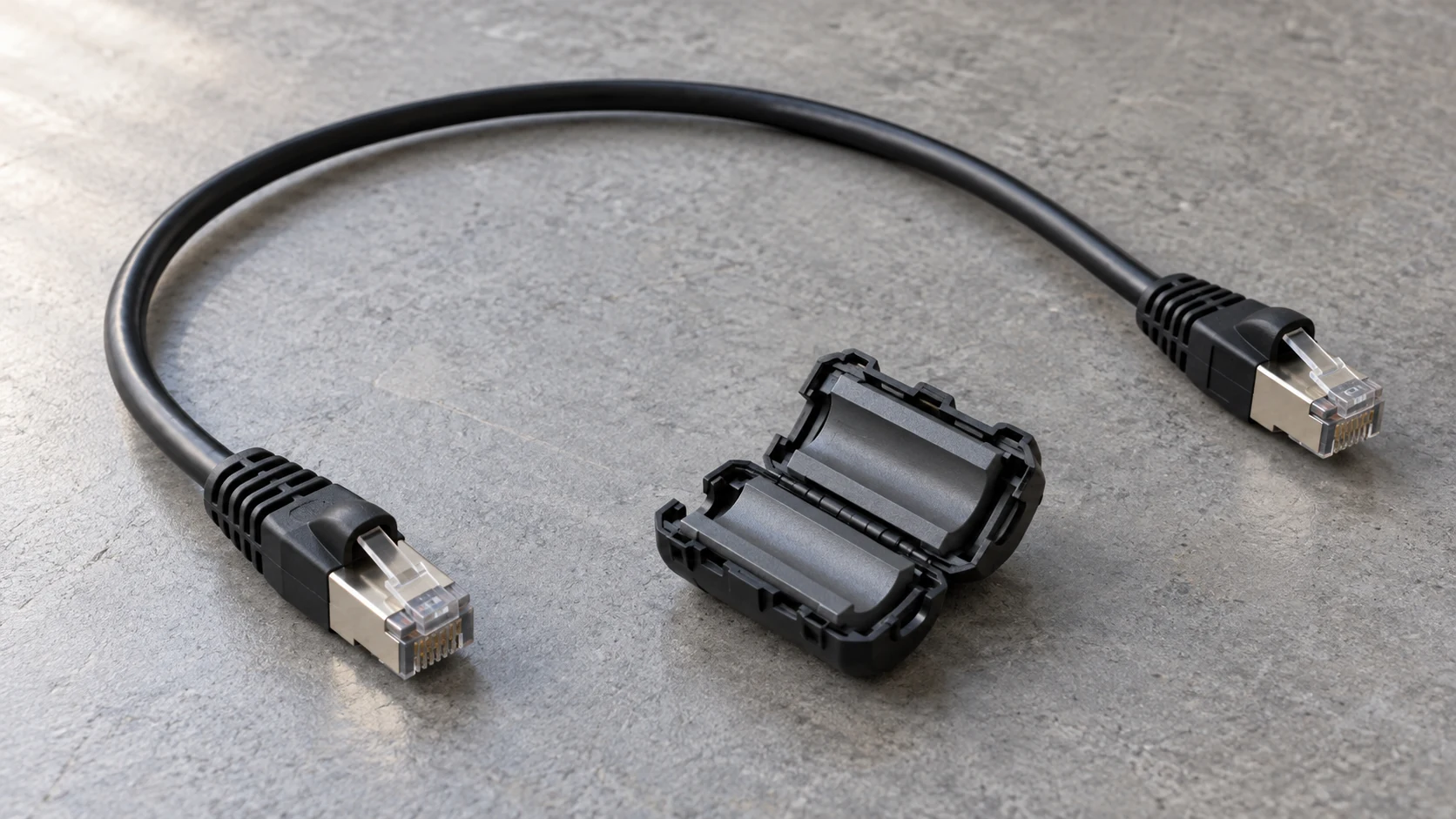
A metal connector shell does not visually establish the whole cable’s shielding construction. Likewise, a ferrite clamp in a photograph does not establish its specification, placement or suitability. Do not ask the installation crew to improvise either item from a picture. Request a controlled parts description and the relevant installation instructions.
Use the connector-standardization guide to keep connector and cable identity clear. The EMC review adds a different question: were these parts and arrangements included in, or properly addressed by, the evidence being relied on? Mechanical fit alone does not answer it.
Read the outcome and conditions together
A pass summary is only the beginning of the result review. Ask which tests were performed, which ports or configurations were assessed, what criteria were used, and whether limitations or deviations are recorded. Have the technical reviewer resolve unfamiliar abbreviations rather than interpreting a blank field as a pass.
For immunity evidence, ask what functions were observed and how any temporary change, interruption or recovery was evaluated under the stated criteria. Your project may separately require a certain recovery behavior, but a buyer’s operational preference should not be silently substituted for the report’s criteria.
For emissions evidence, let the competent reviewer interpret the measurements, limits and any stated uncertainty. Purchasing should retain the conclusion and applicable conditions, not create a new pass margin from an isolated chart. An unexplained result needs clarification; it does not justify guessing either compliance or failure.
Map the report to the quotation
A short comparison sheet helps purchasing separate a missing document from a genuine configuration difference. Keep the fields narrow enough that the supplier can answer them without sending a generic brochure.
| Quotation item | Evidence to connect | Question to resolve |
|---|---|---|
| Cabinet and electronics revision | Tested model and configuration record | Is the offered build identified or technically covered? |
| Controller and operating modes | Equipment list and mode description | Are the proposed options addressed? |
| External cable assemblies | Setup record and installation instructions | Which types, lengths and accessories must remain controlled? |
| Intended environment | Assessment scope and applicable requirements | Has a qualified reviewer confirmed suitability for this project? |
| Production substitutions | Approved change record | Who reviews differences before dispatch? |
For example, two quotations may name the same screen dimensions while offering different power-supply options. Do not infer that one is unsuitable. Ask each bidder to explain the relationship between its offered build and its evidence. Mark unresolved differences as open items before the order is approved.
The point is to make both quotations comparable. It is not to award the contract to the bidder with the most document pages.
Keep the laboratory configuration and the site scope distinct
The final project can add processors, network equipment, distribution arrangements, longer cable routes and other electronics. Give the integrator the supplier’s applicable installation instructions early enough to use them in design. A requirement that arrives after the enclosure or cable pathway is finished may create avoidable rework.
The supplier should identify the equipment and conditions its evidence addresses. The integrator should document the proposed system arrangement and route unresolved differences to the responsible reviewer. Qualified electrical professionals must handle electrical safety, protective connections and local requirements; this article is not a wiring procedure.
For an EU fixed installation, Annex I of the Directive addresses good engineering practice and respecting component intended-use information. Other destinations have their own requirements. Do not generalize an EU document into worldwide approval, or assume that every installed assembly follows the same assessment route.
Control changes without assuming every change requires a new test
Replacement power supplies, board revisions, cabinet alterations, cable substitutions and added controllers should have a defined review path. A change does not automatically require every test to be repeated. It does require the responsible technical party to decide whether existing evidence remains applicable and what additional action, if any, is needed.
Connect that decision to the order’s serial and batch traceability records. Record the accepted configuration, the approved differences and the person who authorized them. Otherwise a report may remain in the project folder while the actual supplied build becomes difficult to identify.
Carry the same information into spare-parts purchasing. An alternative component may be physically compatible yet still need a configuration review. Avoid treating “equivalent” as a complete technical description when the original approval depended on named parts or conditions.
Put document review and resolution costs into the order
Agree when relevant reports and instructions must be available: during quotation, before production approval or before dispatch. Assign an approver and a deadline to every open item. This protects the schedule without pretending that a document can be produced instantly after manufacture.
State who will arrange any additional review or testing, how scope and cost will be agreed, and what happens if the offered configuration cannot be supported by the expected evidence. Keep these commercial terms separate from a technical conclusion. A warranty promise does not replace an assessment, and a report does not define every service obligation.
The warranty-terms guide can help frame support responsibilities. Include document access, replacement-component approval and site-response ownership in the relevant contract discussion. Do not promise universal compliance or guaranteed absence of interference as a casual sales sentence.
A practical approval gate before shipment
Before releasing the order for dispatch, close these six items:
- Link the quotation’s exact build and options to the report or a documented technical review.
- Identify emission and immunity coverage, applicable editions and the intended environment.
- Retain the relevant setup, operating modes, cable descriptions and installation conditions.
- Resolve limitations, deviations and differences through the named technical approver.
- Record accepted production substitutions and the spare-parts review path.
- Agree who owns remaining installation review, document delivery and any additional cost.
Keep the answers in one controlled folder. A long email chain with different attachment versions makes a later review unnecessarily difficult. Name the current approved records and preserve the earlier versions as history, not competing instructions for the installer.
Conclusion: buy a documented configuration, not a badge
Useful LED display EMC reports connect the evidence to the equipment, operating conditions and installation instructions behind the quotation. The right next step is not automatically more testing. It is a traceable review of what is covered, what differs and who can approve the difference.
For a relevant supplier discussion, send Mirun Hailian your project details: destination market, intended environment, display dimensions, cabinet and controller options, external cable arrangement, nearby equipment, required documents and approval schedule. Ask which configuration-specific evidence is available before agreeing the order scope.
Buyer FAQs
Does an EMC report replace an EU declaration of conformity?
No. They have different roles. A test report records the identified assessment and results; a declaration identifies the apparatus and the conformity being declared. For an EU order, have the responsible specialist review the required documentation together rather than accepting one file as a substitute for all others.
Does a report for one cabinet prove every wall size is covered?
Not automatically. Ask how the tested arrangement represents the offered configuration and intended use. The answer may require a documented technical explanation or further assessment. Do not extrapolate coverage from cabinet quantity alone.
Can a ferrite clamp fix any interference issue?
No universal fix should be assumed. The responsible engineer needs to identify the issue and select an appropriate approach. A generic accessory photo is not a component specification, a diagnostic result or proof that the installation meets its requirements.
Need help choosing the right LED display?
Tell us your installation scene, screen size, pixel pitch target and timeline. Mirun Hailian can help match the right product configuration.