Choose a single-sided outdoor LED sign when the people who need the message approach from one useful direction. Choose a double-sided outdoor LED sign when two opposing approaches both matter and each face can be read before people pass the decision point. If the routes approach from different angles or turn at different points, compare two separately aimed displays.
Which configuration should go on the shortlist?
| Site and audience | Starting configuration | Evidence to request |
|---|---|---|
| One active entrance with a clear approach along a wall | Single-sided wall-mounted sign | Sightline from the entrance approach, plus the approved service clearance |
| One sign location serves two opposing routes | Double-sided sign | A readable approach from each direction and a plan to service both faces |
| Two audiences approach at an angle or need the message at different points | Two separately positioned displays | A marked position and a live content test for each route |
A single-sided sign has one active LED face. A double-sided sign has two active faces aimed in opposite directions, commonly using one supporting structure. A proposal may use two display cabinets mounted back to back or an assembly supplied as a unit. Daktronics, for example, lists single-face and back-to-back configurations for its Galaxy GS6 range. Ask your supplier to draw the exact assembly and state which parts are shared. Daktronics GS6 display configurations
Walk both routes before choosing the sign position
Mark the people who need the message and the decision they have to make, such as choosing an entrance or finding a reception desk. On a site plan, mark the first point where the whole message can be read and the last useful point before the reader turns, passes the sign or reaches the entrance. Check the view on site at the normal operating times. Trees, parked vehicles, walls and reflections can affect each direction differently.
For a single entrance, the easiest comparison may be between a screen on the wall and a freestanding sign further along the approach. Where the available wall already faces the audience, a single face may cover the whole job. Walk the route at a normal pace with a sample of the actual message. Ask a person unfamiliar with the site to say which entrance they would take after seeing the display.
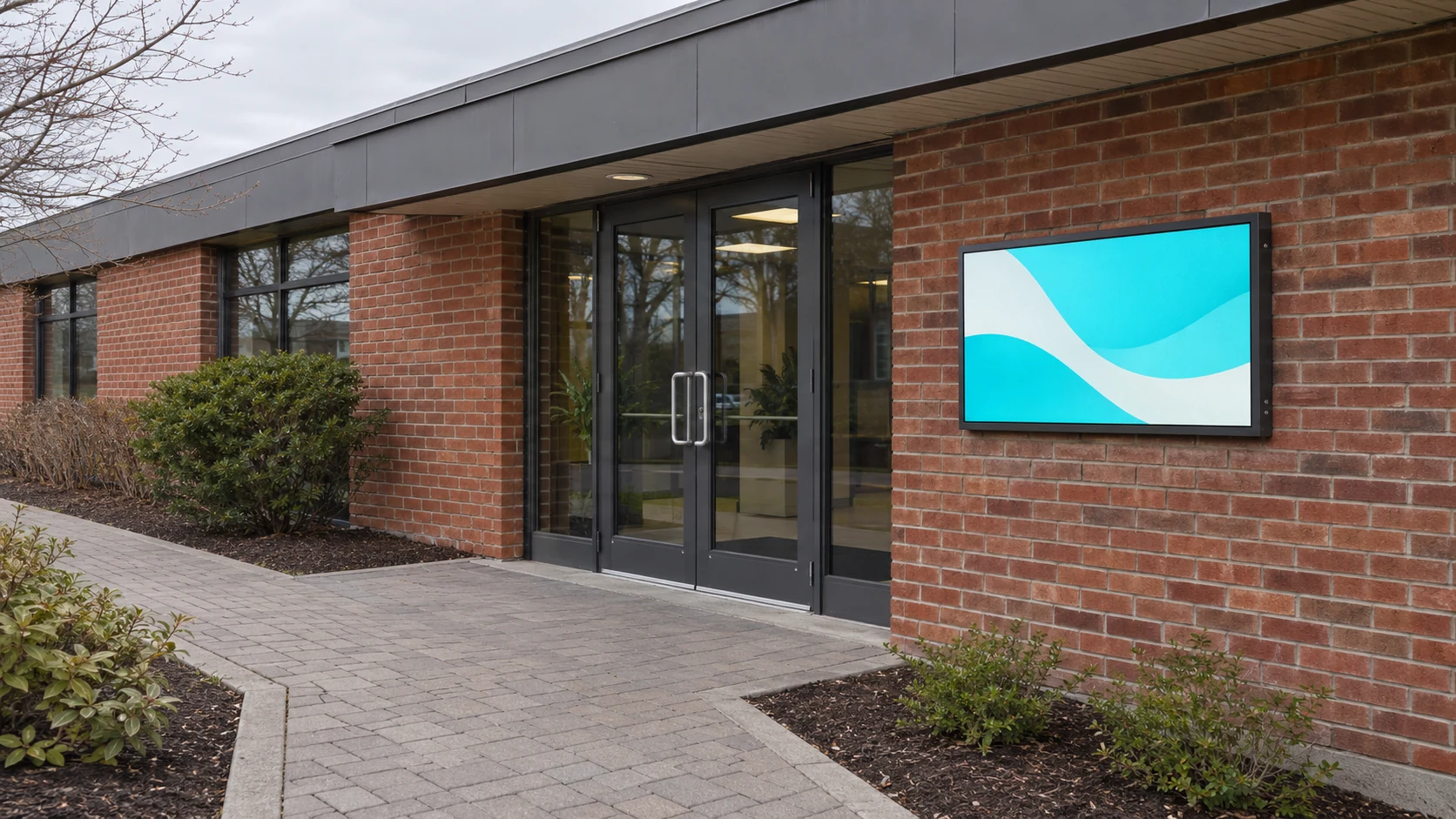
For two approaches, mark Face A and Face B on every plan and quotation. Review each from its own approach. A manufacturer’s viewing-angle specification is useful for screening products. The site demonstration should still check whether someone can read the smallest essential line at the intended angle and distance. Request the active image dimensions and cabinet orientation for each proposed display. Outdoor LED display options
How much useful reading time does the second face add?
Suppose a sign serves an entrance off a pedestrian promenade. The east approach offers 12 m over which the test message can be read before the turn. Landscaping leaves the west approach with 4.2 m. Assuming both people walk at 1.4 m/s, the east approach gives about 8.6 seconds and the west approach 3 seconds. Divide the clear reading distance by walking speed to estimate each window.
These are example inputs. If the entrance instruction appears only during one part of a repeating playlist, a person on the shorter route can pass the turn while a different slide is playing. For that face, test a persistent entrance instruction or move the display to a position that creates a longer readable approach. If a priority route still fails the test, quote a separately positioned display for it. Use the walking speed, sightlines and content observed at your site. Traffic-facing projects need their own site and approval review.
Decide whether the faces need the same message
Specify the content mode in the purchase brief. If both faces show the same campaign, confirm how the controller distributes one approved schedule and how the operator verifies playback on each face. If people need different directions or opening information, require independent scheduling and preview for Face A and Face B. Match each directional graphic to the actual view. An arrow copied unchanged to the opposite face can send visitors the wrong way.
Ask the supplier to show the actual player and software with one scheduled change on both faces. Where independent scheduling is required, ask them to update only Face B and confirm what Face A continues to display. If both faces must stay on the same schedule, test their combined update and confirm the expected behavior following a restart or a network outage. Daktronics documents a specific configuration in which a schedule sent to only one face can leave the other face showing old content. Confirm how your proposed equipment handles updates. Daktronics two-face schedule support note
Each face also has its own light conditions. One may face open sky while the other sits in shade. Ask whether brightness is controlled together or separately and how the installer will verify the result for both approaches after dark. Use the automatic brightness control guide to define what the operator needs to adjust or check.
Compare the installed scope and service access
Ask for the price of the complete installation, with the number of active faces listed explicitly. Compare cabinet depth and weight, support and foundation scope, power and signal routes, controller and software, commissioning, and access for repair. For two faces, get the maximum input power and typical operating power. Ask for the brightness and content conditions used for the typical figure, and confirm whether each value covers one face or the full assembly. Have the project electrician and structural designer review the actual configuration for the site.
Have the supplier show, on a section drawing, how a technician reaches a module, power supply and controller on each face. Check whether a narrow gap between the cabinet backs limits access and whether each cabinet can be serviced from the front. Confirm whether work on one face takes the other out of service, and who supplies any access equipment the site needs. The front versus rear service guide explains why the access route belongs in the purchasing brief.
What should be in the purchase order?
Give bidders the same site plan and sample message so you can compare the installation they actually propose.
- Mark the covered routes, decision points and Face A and Face B positions.
- Attach the active dimensions, support interfaces, power and signal scope, and service access shown on the proposed drawings.
- Specify the playlist and brightness behavior per face, including what should happen after a restart.
- State how the buyer will check readability from each approach and verify the scheduled update before accepting the sign.
Approve the configuration that covers each required route and passes the real-content demonstration. If one face passes every required check, price that complete installation first. If two approaches need coverage, buy the second face only when it passes its own reading, operation and service checks. To request a comparable proposal from Mirun, share the site location, approach photos, target sign dimensions, sample messages, hours and expected mounting arrangement. Send your outdoor signage brief
Need help choosing the right LED display?
Tell us your installation scene, screen size, pixel pitch target and timeline. Mirun Hailian can help match the right product configuration.