An LED display may spend weeks in a warehouse before the installation team sees it. Spare modules may wait much longer. Buyers often approve brightness, pixel pitch and delivery dates carefully, then leave storage conditions to a note saying “keep dry.” That instruction is difficult to follow when equipment moves between a cold vehicle, a warm loading area and an air-conditioned room.
Good LED display storage starts with the exact model’s written storage limits, approved packaging, an environmental record and a defined release procedure before power-up. Do not energize equipment with visible moisture, suspected water ingress or an unresolved condensation concern. Keep it out of service and obtain the manufacturer’s instructions through a qualified service team.
This guide helps procurement teams, warehouse operators and integrators agree responsibilities before delivery. It is not a drying recipe or a substitute for the product manual. Recovery temperatures, brightness ramps and waiting periods must be specified for the actual equipment.
Separate three different moisture questions
Humidity describes moisture in the air, but it does not tell the whole story. Condensation concerns liquid water forming when conditions around a surface reach saturation. Moisture absorption concerns water entering susceptible materials over time. A cabinet can look dry without that visual check proving that every component is ready for normal operation.
The U.S. National Weather Service explains dew point as the temperature at which air reaches saturation when cooled. For equipment planning, the important implication is that a cold surface brought into warmer, humid air may experience condensation. Room temperature and relative humidity need to be interpreted together with the equipment’s temperature history.
ROE Visual’s public introduction to moisture in LEDs notes that LEDs can absorb moisture while unused and warns about heating moisture-containing LEDs too aggressively. This explains why a storage-to-service procedure matters. It does not establish a universal restart program for every LED package or cabinet.
Replace “Is the screen moisture-proof?” with three questions: what storage environment is permitted, how should environmental transitions be managed, and what must happen before equipment returns to service after an abnormal exposure? Each needs a written answer.
Ask for storage limits, not only operating limits
A data sheet may list an operating range and a separate storage range. Confirm which conditions apply while cabinets are unpowered, how long they apply, and whether the specification includes a non-condensing condition. Request the manual revision and the exact product configuration covered by the answer.
Do not interpret a broad temperature range as permission for rapid transfers between its extremes. Likewise, a permitted humidity range does not automatically authorize condensation. Ask whether the supplier requires monitoring, periodic inspections or a particular maintenance routine during extended non-use.
Include loose modules, power supplies, receiving cards and other stocked components in the discussion. Their packaging and handling instructions may differ from those of an assembled cabinet. A spare-parts box should not disappear from the storage plan simply because it is smaller than the main shipment.
Outdoor classification also does not replace a storage procedure. Ask which enclosure faces and interfaces are covered, in what assembled condition, and what changes when connectors are uncapped or service covers are removed. The LED display IP-rating guide helps buyers separate enclosure claims from the conditions of a complete installation.
Check the warehouse your equipment will actually use
Identify every place where the shipment may wait: the receiving bay, temporary project storage, the final equipment room and any third-party warehouse. The best-controlled room is not useful if the cases spend most of their time elsewhere. Ask who controls access, environmental equipment and incident reporting in each location.
Look beyond the average room reading. A door opened frequently for deliveries, a leaking roof, a cold wall or a shutdown of environmental controls can change the conditions around a particular group of cases. Ask the supplier and facilities team to agree suitable storage locations and monitoring positions rather than relying on a sensor at the office reception desk.
Keep handling and storage requirements in the same plan. Cabinet orientation, support points, stacking limits, aisle clearance and packaging condition still matter. Moisture control does not compensate for a module face being pressed against an unsuitable divider or a heavy case being placed on an unrated support.
Record conditions where the cabinets are stored
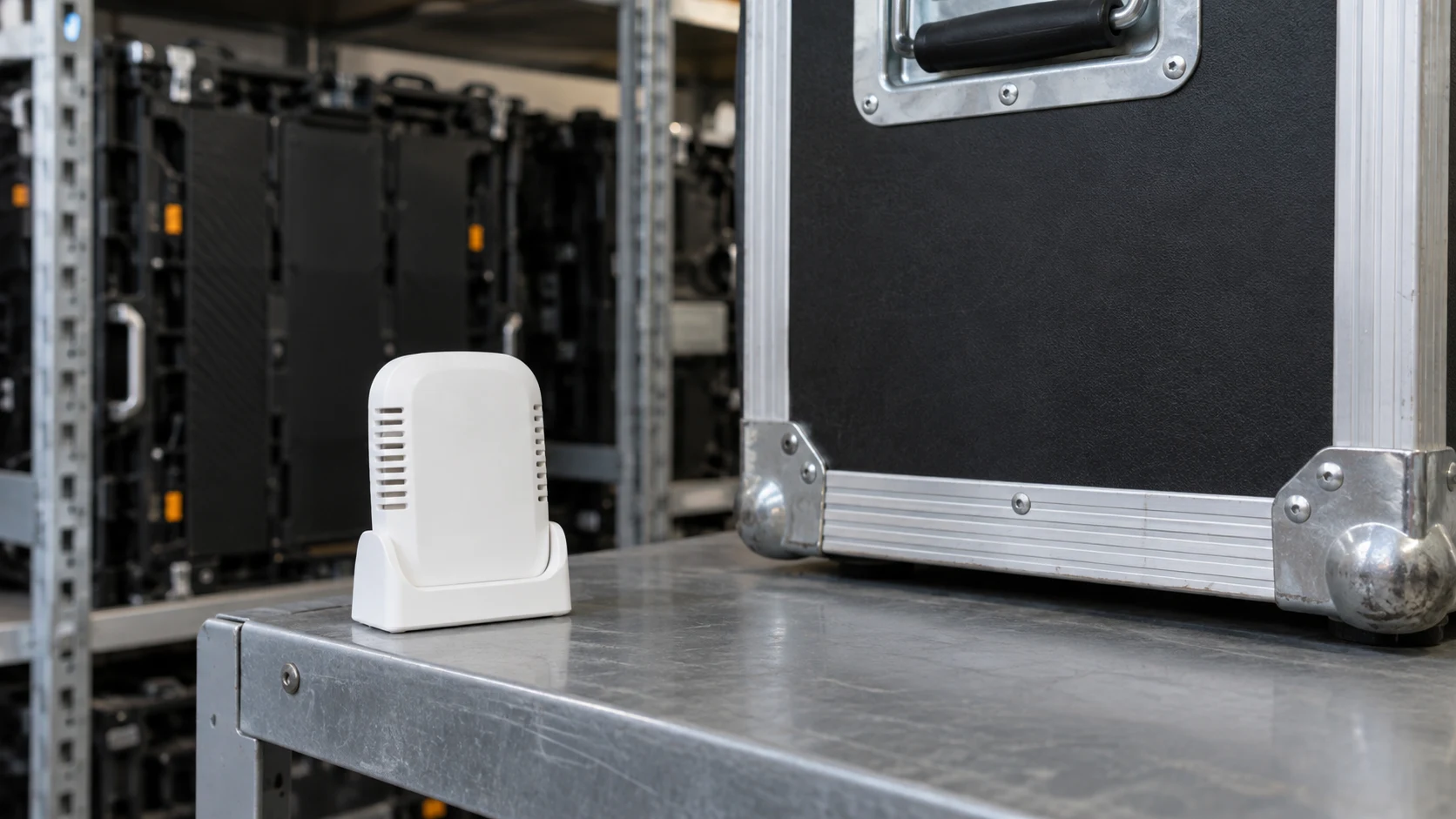
An environmental logger can help show what happened during an unattended period. Specify the temperature and humidity information needed, the recording interval, how records will be retained and who reviews them. Choose instrument accuracy and any calibration requirements with the responsible technical team; this article does not prescribe a universal sensor specification.
A sensor in room air does not measure the microclimate inside a closed case. If the supplier wants measurements within the packaging, agree a suitable method and location that do not damage the package or interfere with its protection. Record what each measurement represents so later reviewers do not compare unlike readings.
An alarm also needs an owner. Decide who receives it outside business hours, what counts as an exception against the approved limits, and which action the person is authorized to take. A record of an excursion is useful evidence, but it is not permission to return the equipment to service without review.
Use case or batch identifiers in the log. If only one storage zone had a problem, that information helps the service team identify the affected equipment. Retain relevant records through commissioning and alongside any later inspection report.
Do flight cases and desiccants solve the problem?
Flight cases provide a defined transport and handling system when designed for the cabinets, but their appearance does not prove moisture-barrier performance. Ask what the supplied packaging is intended to protect against, whether a separate barrier package is included, and how it should be resealed after inspection.
If the supplier specifies desiccants or humidity indicators, ask for the approved type, quantity, placement, inspection method and replacement criteria. Do not add an arbitrary packet and call the shipment protected. Equally, a humidity indicator is not a certificate that an LED module is internally dry.
Agree how wet, damaged or questionable packing material is handled before reuse. Simply closing the case again does not resolve the condition that triggered concern. For mechanical protection, receiving photos and transport responsibilities, use the related LED display packaging checklist.
Plan the transition into the installation room
A plausible handover problem is a shipment arriving from a cold vehicle at a warm venue shortly before installation. The crew wants to open every case and begin testing immediately. The receiving plan should already say who checks the conditions, where equipment waits and who releases it for unpacking and power-up.
Ask the manufacturer for the acclimatization procedure, including whether packaging remains closed during any part of the transition. Do not invent a fixed waiting time from another product’s manual. The starting conditions, cabinet construction, packing arrangement and destination environment can change the required approach.
Schedule that allowance before the commissioning deadline. If the supplier’s procedure requires additional checks after prolonged storage, those checks need time, access and an assigned technician. A project schedule that allows only unloading and mounting has not allowed for the full handover.
If moisture or suspected ingress is discovered, stop the release process. Keep the affected equipment unpowered, identify it clearly and refer the condition to the qualified service team. Do not improvise with heat guns, ovens, direct heaters or a full-brightness white image to “dry it quickly.” Use only a procedure explicitly approved for the equipment and exposure involved.
Agree who decides that stored equipment is ready
A short responsibility table can prevent the warehouse team from being expected to make a technical safety decision. The following is a proposed division of work to agree for the project, not a universal contractual rule.
| Decision | Suggested owner | Evidence to retain |
|---|---|---|
| Permitted storage and restart conditions | Manufacturer or authorized technical support | Model-specific instructions and revision |
| Routine storage records and exception reporting | Warehouse or facilities team | Location, dates, readings and incident record |
| Assessment after suspected moisture exposure | Qualified service team | Inspection findings and approved next action |
| Acceptance for installation and normal operation | Designated commissioning lead | Release record and completed functional checks |
After the equipment has been cleared under the applicable procedure, complete the agreed functional and visual checks. Record cabinet or module identifiers, any abnormal behavior and any replacements. A normal-looking image after one startup is not a substitute for the supplier’s release requirements.
Retain a baseline from initial acceptance so a later issue can be compared with an identified configuration and date. Make sure the operator knows where the approved instructions are stored, rather than relying on a verbal assurance from the installation day.
Include spare inventory and delayed projects in the quotation
Storage risk does not end when the main wall is installed. Replacement modules may sit unused through several seasons, while a delayed project may extend a planned short warehouse stay substantially. Ask what changes in the care plan when the expected non-use period changes.
Keep an inventory of storage dates, packaging status and required inspections for spare components. Combine this with spare-parts planning so compatibility and readiness are reviewed together. A physically compatible module is not automatically ready to install after unknown storage conditions.
Compare quotations on included responsibilities: suitable packaging, monitoring where required, storage instructions, technical assessment after an exception, and any restart support. Ask which party carries out these tasks if delivery is early or the site is not ready. Do not assume that a warranty or a delivery term resolves every storage responsibility; request the relevant written scope and conditions.
What should buyers send with the storage brief?
A practical LED display storage plan connects the product instructions to the actual route, warehouse and commissioning schedule. The useful outcome is not simply a lower humidity reading. It is equipment with a known history and a clear, authorized path back into service.
For a discussion with Mirun, send the project and storage brief: product type, cabinet and spare quantities, destination, expected storage duration, available environmental controls, transport stages and installation date. Ask for model-specific limits, packaging requirements and a named escalation route before approving the delivery plan.
Storage questions buyers often ask
Can an unused indoor LED display stay packed indefinitely?
Do not assume so. Ask the manufacturer about permitted storage duration, environmental conditions and any periodic inspection or maintenance requirements. Sealed packaging and an unopened case do not remove the need to follow those instructions.
Is an air-conditioned room enough?
Not by itself. Confirm the actual temperature and humidity history, whether controls run during closures, and how equipment transitions into and out of the room. The room label is less useful than records showing that the approved conditions were maintained.
Can we use a dehumidification mode after a water leak?
Do not treat a built-in mode as clearance to power water-exposed equipment. Keep it out of service and have the manufacturer or qualified service team assess it. A prescribed humidity-management feature and recovery from liquid ingress are different situations.
Need help choosing the right LED display?
Tell us your installation scene, screen size, pixel pitch target and timeline. Mirun Hailian can help match the right product configuration.