A replacement LED module can arrive in the right carton and still reach the service desk through an uncontrolled handling route. For buyers, the useful question is not simply whether an “anti-static bag” is included. It is who may open that bag, where the exposed assembly may be placed, and how a removed module will be packed for return. LED module ESD handling belongs in the spare-parts handover, before the first on-site replacement.
The practical answer: ask the supplier to identify sensitive assemblies, specify suitable packaging and the approved service environment, and assign someone to maintain the handling procedure. Agree on checks and training for the actual work location. A mat or wrist strap alone is not a complete handover, and this guide is not a substitute for the product’s service instructions.
What does ESD mean for an LED display buyer?
ESD means electrostatic discharge: a rapid transfer of electrical charge between objects at different electrical potentials. The EOS/ESD Association’s introduction explains that it can damage electronic devices or disturb their operation. Handling and separating materials can generate charge, and susceptibility varies by device. This makes a product-specific handling instruction more useful than a generic claim that all electronics need the same precautions.
Start by separating the assembled screen from the parts your team will actually handle. A closed cabinet, an exposed module, a receiving card and a loose driver board are different service states. Ask which items the manufacturer identifies as electrostatic-discharge-sensitive, and what changes when a cover or protective package is removed. Do not assume that a finished display’s specification describes every exposed assembly.
This is also separate from mains electrical safety, mechanical protection and moisture management. ESD controls do not make energized equipment safe to touch. Qualified service personnel must follow the manufacturer’s isolation and access procedure; procurement should not turn this article into instructions for live repairs or improvised grounding.
Define the protected boundary before buying accessories
The Association’s principles of ESD control describe a coordinated program rather than a single protective product. For a buyer, the implication is straightforward: the quotation should explain the handling location, relevant procedures, training and verification, not merely list accessories. The site conditions and the assemblies being handled determine what that program needs.
Ask the service provider to mark the boundary between protected transport and exposed handling. Who receives the parcel? Does incoming inspection require opening individual module packages? Where does the technician unpack a spare? Where does the removed part wait while its replacement is installed? These questions expose gaps that an equipment list cannot show.
An electrostatic protected area, or EPA, is the designated environment for handling sensitive items with appropriate controls. Have its suitability assessed by a qualified person responsible for the site’s ESD arrangements. A permanent workshop may suit a fixed venue. A touring team may need a supplier-approved field arrangement. Neither should be accepted just because a work surface happens to look like a service bench.
Consider a venue where spare modules are stored in a back office but replacements happen at the screen. The buyer’s task is to agree where the package is opened and how the part travels between locations. If the proposed route leaves the assembly exposed without an approved procedure, request a revised service plan before signing off the handover.
What should the LED module ESD handling scope include?
Use a small responsibility matrix to turn the discussion into a deliverable. The following is a procurement checklist, not a universal certification requirement. Ask suppliers to fill it out for the module and service arrangement being offered, and record exclusions rather than treating a blank cell as acceptance.
| Decision | Evidence to request | Responsibility to name |
|---|---|---|
| Which parts need protection? | Assembly identification and applicable manufacturer handling instructions | Supplier technical contact |
| Where may packages be opened? | Approved work area and field-service procedure | Site service lead |
| How are parts transported? | Packaging specification, closure and reuse instructions | Supplier and receiving team |
| How are controls maintained? | Verification method, records and replacement criteria | Responsible qualified person |
| Who may replace a module? | Product-specific training and authorization record | Integrator or maintenance provider |
| How are suspect parts returned? | Identification, handling history and return-packaging instructions | Service coordinator |
Keep this scope alongside the LED display spare-parts package. Spare quantity, compatible revision and protective handling answer different questions. A replacement can be electrically compatible but lack a documented route from storage to installation. Conversely, careful handling cannot make an incompatible board suitable for the display.
ESD protective packaging: ask about properties, not color
The Association’s guidance on procedures and materials distinguishes packaging used within a protected area from packaging used outside it. For sensitive items outside the EPA, its guidance includes discharge shielding in addition to low-charging and conductive or dissipative properties. Request the packaging specification for the actual transport route; a color description does not establish those properties.
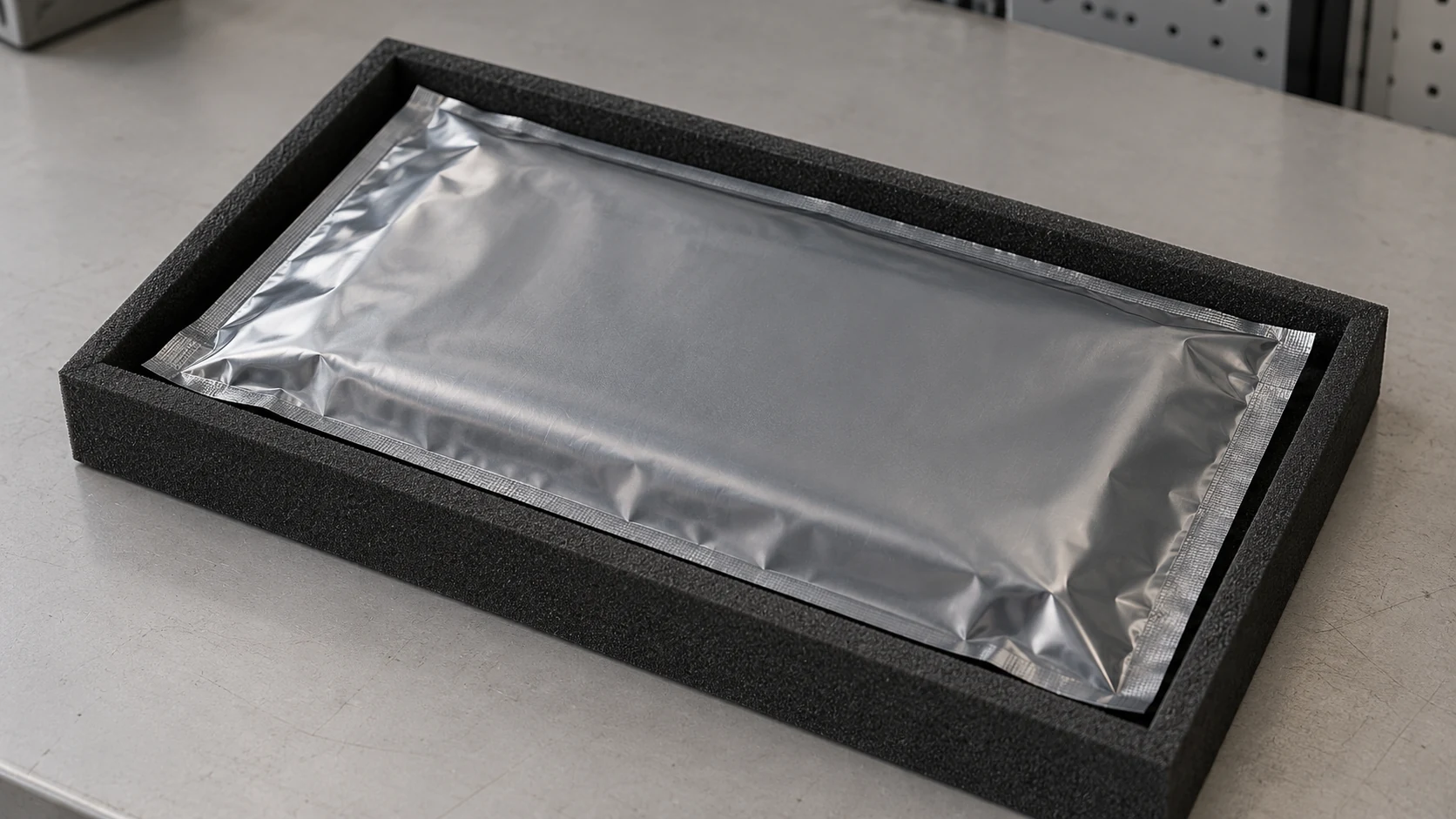
For LED display spare modules, ask the supplier to identify the packaging supplied around each loose assembly, not only the outer shipping case. Request its product reference, relevant performance documentation, closure instructions, inspection criteria and reuse limits. If cushioning or dividers are included, have the supplier explain how the complete package is intended to be used. Do not silently substitute ordinary bubble wrap because its dimensions fit.
Plan for the return journey as well. After a replacement, the removed module may need a suitable package even if it is suspected to be faulty. Agree whether the new module’s packaging can be reused, whether extra return packaging is included, and where it will be kept. The packaging instructions should remain available after the original installer leaves.
Moisture and impact protection need their own confirmation. A carton, padded flight case or moisture barrier is not, by its appearance alone, evidence of discharge shielding. The LED display storage and moisture guide addresses a different part of the storage decision. For this purchase, ask how the specified package meets each relevant requirement without assuming one label covers all risks.
Approve the workstation and field-service method together
Ask the supplier and maintenance provider to describe the proposed handling arrangement in the actual service location. Specify who is responsible for assessing it, which equipment is included, and what checks must be recorded before use. Let qualified personnel determine suitable grounding and verification arrangements; do not ask an operator to invent a connection to nearby metalwork.
The Association’s materials guidance also explains that some insulating materials cannot be discharged simply by grounding them. This is another reason to request a reviewed workstation arrangement rather than equating “grounded” with “everything controlled.” The site assessment should address the relevant materials and handling activity, not just the presence of a lead or mat.
Define what happens when the normal arrangement is unavailable. For example, a contracted technician may attend during a busy event, find the service bench occupied and be asked to work at a reception table. The handover should state who can approve an alternative method and when work must wait. A planned escalation route is more useful than a vague instruction to “take care.”
Budget for maintaining the arrangement, not just purchasing it. Ask which control items need periodic verification, who keeps the records, and what triggers replacement or reassessment. Do not invent a universal inspection interval: the responsible specialist should define one appropriate to the equipment, use and risk. Include field kits if the service model depends on them.
Make the handover a practical exercise
A short demonstration can reveal whether the written process is usable. Ask the authorized service team to walk through receiving a protected spare, locating its identity, preparing the approved handling area, following the product-specific replacement procedure, and packaging the removed assembly. Use the agreed training method and keep sensitive items protected throughout; this is not an invitation to improvise a repair test.
Record who attended, which product revision and procedure were covered, and which tasks the operator is authorized to perform. Include the location of packaging, service contacts and the escalation route. Connect these records to the broader LED display maintenance training handover so a new shift does not inherit a box of accessories without instructions.
A completed exercise demonstrates that the team has rehearsed the agreed workflow. It does not certify the whole facility, prove a particular level of ESD protection, or replace technical verification. Keep those acceptance items separate. If the supplier promises a certified control program, request the scope and supporting evidence rather than extending that claim to every future service location.
Keep fault records neutral and useful
If a pixel defect or board fault appears, record the assembly identity, symptoms, timing, service actions and handling route. Follow the supplier’s return instructions and retain relevant packaging information. Do not label the fault “ESD damage” solely because it appeared after a replacement; several causes may need investigation, and a functional screen test is not a diagnosis of the cause.
Agree on the reporting process and evidence needed before an incident occurs. The commercial question is how suspected handling damage is evaluated, not whether every later failure can automatically be assigned to the operator. Check the LED display warranty terms alongside the handling instructions, particularly where responsibilities pass between supplier, integrator and third-party maintenance provider.
What to include in your RFQ
For a useful LED module ESD handling discussion, send Mirun the display application, proposed module or cabinet configuration, service location, spare-storage arrangement and expected replacement workflow. Identify whether maintenance will be carried out by your staff, the integrator or a traveling contractor. Ask which assemblies require controlled handling and what documentation, packaging, training and field support are included.
Use the Mirun project contact page to request a product-specific handover scope. Keep your request concrete: who opens the spare, where it is handled, how controls are maintained, and how a removed assembly goes back. Those answers help compare quotations on a workable service process rather than on the number of accessories in the carton.
Buyer questions
Does a pink bag prove that a spare module is discharge-shielded?
No. Bag color is not a packaging performance specification. Request the supplier’s identification and documentation for the required properties, plus instructions for closing and using the package on your actual route.
Does adding a wrist strap make any table a suitable service area?
No. Suitability depends on the complete handling arrangement and its verification. Have the responsible qualified person assess the location and follow the manufacturer’s service and electrical-safety instructions. An accessory alone is not approval to work there.
Can a passed pixel test prove that ESD handling was adequate?
No. A pixel test reports the display’s behavior under that test; it does not verify packaging properties, workstation controls or the handling history. Use the agreed control checks and records for those acceptance questions, and obtain appropriate fault analysis when a cause needs to be established.
Need help choosing the right LED display?
Tell us your installation scene, screen size, pixel pitch target and timeline. Mirun Hailian can help match the right product configuration.