Choosing between a fixed LED display and a rental LED display can look like a simple question about installation time. It is not. The two systems may use similar LED modules, pixel pitches, controllers, and even screen dimensions, yet their cabinet hardware is built around different operating routines. One is usually installed for long-term service in one location. The other is designed to be assembled, handled, transported, and rebuilt repeatedly.
The useful buying question is therefore not “Which type is better?” It is “Which cabinet design still makes sense after the installation schedule, handling frequency, structure, service access, content, and budget are defined?” A permanent lobby wall, a touring stage screen, and a seasonal exhibition booth may all need a large LED canvas, but they should not automatically use the same hardware.
Which Project Conditions Should Decide Between Fixed and Rental LED?
Start with the operating plan. Screen width and height matter, but so do installation duration, expected setup cycles, lifting method, maintenance route, storage, transport, indoor or outdoor exposure, camera use, and the people who will handle the equipment.
Will the screen stay in one location?
A fixed LED display is normally planned around one building, structure, or media position. The supporting frame, cable routes, ventilation, finish, and service access can be designed for that site. Once installed, the cabinets are not expected to be moved after every campaign or event.
This approach fits many retail walls, corporate lobbies, control rooms, transport hubs, building facades, and roadside displays. Buyers can review indoor LED display configurations or outdoor fixed-display configurations according to the actual environment.
A rental LED display becomes more relevant when the same cabinet inventory must support different screen sizes, venues, or layouts. Concerts, festivals, exhibitions, corporate events, studios, and touring productions often value fast assembly and repeatable handling more than a site-specific permanent finish.
Does rental LED mean the screen must be rented?
No. In product discussions, “rental LED display” usually describes the cabinet design and its intended handling cycle. Event companies, production suppliers, venues, and integrators often purchase rental cabinets as reusable inventory. A brand may also own rental-style cabinets for recurring exhibitions or temporary installations.
The label does not decide the business model. The installation and handling routine should decide the cabinet type.
How Does Cabinet Hardware Change the Choice?
The largest practical differences often appear on the back and edges of the cabinet, not on the image surface.
What makes a cabinet suitable for repeated setup?
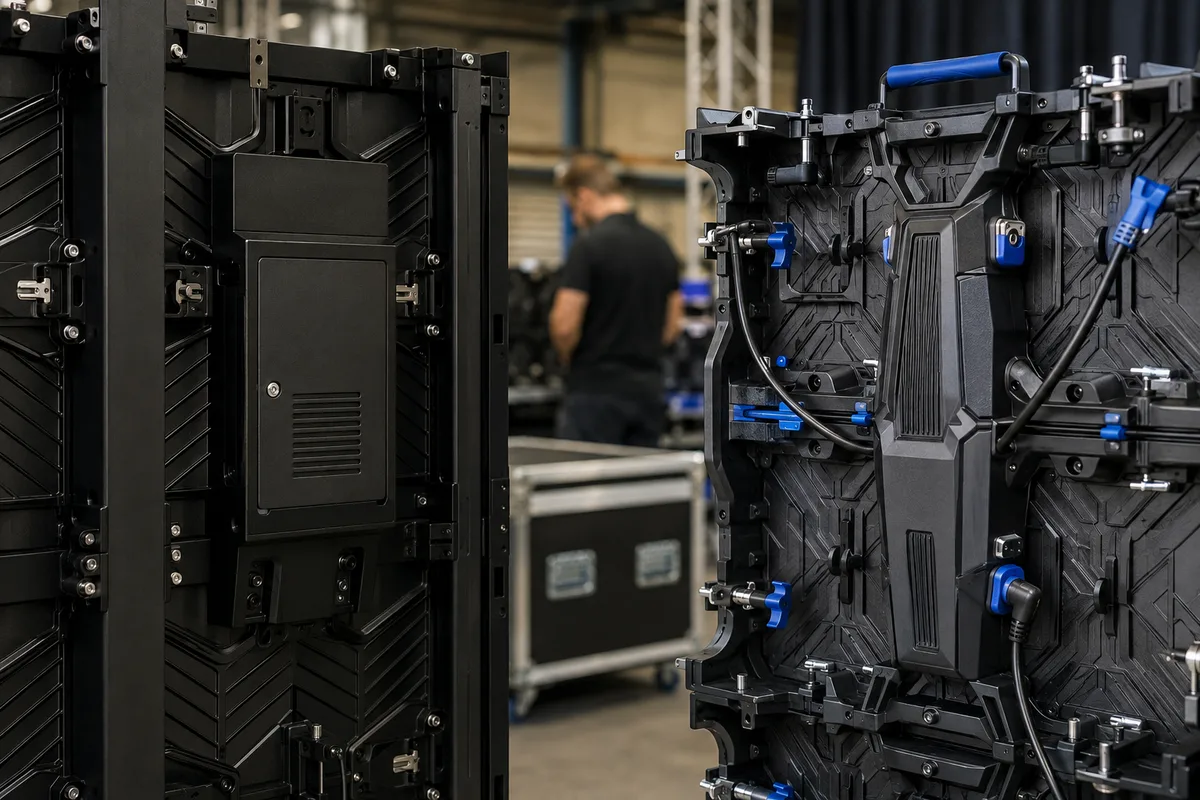
Rental cabinets commonly use integrated handles, fast locks, alignment hardware, and quick power and signal connections. These details help crews lift, position, connect, and remove panels under event deadlines. Die-cast cabinet construction is also common because consistent cabinet geometry helps repeated alignment.
Those features are useful only when they match the real workflow. Ask who will handle the cabinets, how often the screen will be rebuilt, whether panels will be ground-stacked or flown, and how damaged locks, corner protectors, cables, or modules will be replaced between events.
For a permanent wall, fast locks and carrying handles may add less value than cabinet depth, structural attachment, weather protection, ventilation, or access to internal components. A fixed cabinet can be optimized around the opening and maintenance plan instead of repeated transport.
Do cabinet dimensions matter after the screen size is known?
Yes. Cabinet format affects panel count, handling weight, seam count, flight-case quantity, spare inventory, and the screen dimensions that can be assembled without partial cabinets.
A rental inventory may combine compatible 500 × 500 mm and 500 × 1000 mm cabinets to build different layouts efficiently. That does not mean every cabinet with matching outside dimensions is electrically or mechanically interchangeable. The series, module, receiving card, power arrangement, locks, and pixel matrix still need to match. Buyers comparing these formats can use the 500 × 500 vs 500 × 1000 cabinet guide to check the layout tradeoffs.
How Do Installation and Maintenance Change the Answer?
A screen should be selected together with the structure and the service route. Cabinet type alone does not approve a wall mount, ground stack, hanging system, facade frame, or freestanding structure.
What should buyers confirm about the supporting system?
For fixed installation, define the wall or structure, attachment points, installation depth, cable entries, ventilation, drainage where relevant, and who is responsible for structural design. Outdoor projects also need site-specific engineering for local conditions.
For rental use, define the approved hanging or stacking method, maximum intended layout, rigging accessories, ballast or support requirements, and the competent party responsible for each venue. A cabinet described as lightweight is still only one part of the complete suspended or supported system.
Is front service or rear service more important?
Neither direction is automatically better. Front service is valuable when a fixed wall sits close to a finished surface and rear clearance is limited. Rear service can be practical when a permanent maintenance corridor exists. Rental crews may value access from both directions because a fault can appear during a short setup window.
The quotation should name the parts that are actually reachable: LED modules, power supplies, receiving cards, hub boards, cables, and connectors. The broader front-service vs rear-service guide helps teams turn a maintenance label into an access check.
Does Image Quality Decide Between Fixed and Rental LED?
Not by itself. Both categories can be configured for different pixel pitches, brightness levels, grayscale performance, color calibration, and refresh rates. Image quality depends on the complete selected configuration, not only the cabinet label.
What should close-viewing projects compare?
Start with the closest normal viewer, physical screen dimensions, smallest important content detail, and required pixel canvas. A permanent boardroom wall may prioritize close-view text and quiet low-brightness performance. An exhibition screen may need a similar pitch but place more value on portability and rapid repair.
Do not choose pitch from viewing distance alone. Confirm the actual cabinet pixel matrix and calculate the complete screen resolution before approval.
What changes when cameras will film the screen?
Event and studio projects should state camera frame rates, shutter settings, and planned brightness, then test the display, controller, receiving hardware, and camera together. A headline refresh-rate number does not describe every possible shooting condition. The LED display refresh-rate checklist explains what evidence to request.
How Should Buyers Compare Fixed and Rental LED Display Price?
Price becomes misleading when the two quotations solve different operating problems. A fixed-display quote may include a site-specific frame, trim, cable route, ventilation, and long-term maintenance access. A rental-system quote may include hanging bars, stacking hardware, flight cases, fast cabling, spare locks, and extra panels for inventory resilience.
Compare the complete usable system, not only cabinet price or price per square meter.
What can change the total project cost?
- Screen area, pixel pitch, and native resolution
- Indoor or outdoor configuration and brightness target
- Cabinet material, dimensions, weight, and service direction
- Permanent structure or rental rigging and stacking hardware
- Control equipment, power distribution, and signal transport
- Spare modules, power supplies, receiving cards, cables, and locks
- Flight cases, packing, freight, lifting, and on-site labor
- Installation drawings, configuration files, training, and support scope
Power should also be compared with the same assumptions. Use the proposed maximum load for electrical planning and a separately stated operating estimate for energy discussions.
What information should go into the RFQ?
Send the screen width and height, closest viewing distance, indoor or outdoor use, installation duration, expected setup frequency, mounting or rigging method, service clearance, content type, camera requirements, storage and transport plan, destination, quantity, and target schedule.
If the system will be reused, also state the likely screen sizes and layouts across different events. If it will be permanent, include site drawings or photos and identify the team responsible for the support structure, power, data, and finishing work.
Which Cabinet Type Fits Different Projects?
| Project condition | Fixed LED display may fit well | Rental LED display becomes stronger |
|---|---|---|
| Permanent lobby or retail wall | Strong fit | Possible, but repeat-use hardware may add little value |
| Touring concert or festival | Usually impractical | Strong fit |
| Recurring exhibition program | Only if one booth is permanent | Flexible reusable inventory |
| Roadside billboard | Strong site-specific fit | Not the usual choice |
| Broadcast studio | Good for a permanent set | Useful for changing sets and outside production |
| Limited rear access | Plan a front-service cabinet | Confirm actual front and rear component access |
| Frequent transport | Not designed around repeated handling | Handles, fast locks, and flight cases matter |
| Custom permanent opening | Can be configured around the architecture | Standard cabinet increments may constrain dimensions |
The table is a starting point, not a substitute for a site or production plan. A venue can use fixed LED in one room and own rental cabinets for temporary events. A studio can make either choice depending on whether the set changes. The correct answer follows the operating routine.
How Can Mirun Hailian Support Cabinet Selection?
Huizhou Mirun Hailian Technology Co., Ltd. supplies rental, indoor, outdoor, transparent, and creative LED display solutions for commercial projects. The useful starting point is a requirement review covering the screen size, viewing distance, environment, brightness target, installation method, control needs, spare-parts plan, packing, destination, and schedule.
For repeat-use systems, buyers can compare Mirun’s rental LED display families and confirm the series, pitch, cabinet format, locks, handles, service access, cabling, and transport scope. For permanent projects, the team can review the site and determine whether an indoor or outdoor fixed configuration better matches the environment and maintenance plan.
The more complete the input, the easier it is to compare cabinets on project fit instead of a category name.
Conclusion
A fixed LED display is usually the stronger starting point when the screen will remain in one location and the cabinet, structure, cable route, finish, and service access can be planned around that site. A rental LED display becomes more useful when cabinets must move, connect quickly, survive repeated handling, support multiple layouts, and return to service under event deadlines.
Before comparing price, define how often the screen will move, who will build it, how it will be supported, which parts must be serviced, what content and cameras will be used, and what accessories belong in the scope. Once those conditions are clear, the cabinet choice becomes much easier to explain technically and commercially.
FAQs
Q1: Is a rental LED display lower quality than a fixed LED display?
No. Rental and fixed describe different cabinet and operating priorities. Either can be configured with suitable pixel pitch, brightness, refresh rate, grayscale, calibration, and control hardware. Buyers should compare the complete specified configuration and acceptance criteria.
Q2: Can rental LED cabinets be used for a permanent installation?
They can be used in some permanent projects, but buyers should check whether the handles, fast locks, cabinet dimensions, service access, structure, and price make sense for long-term installation. A fixed cabinet may fit the architecture and maintenance plan more efficiently.
Q3: What is the first question to ask a supplier?
Explain whether the screen is permanent or will be rebuilt, then provide the screen size, environment, viewing distance, mounting method, service access, content, camera requirements, destination, and schedule. Ask the supplier to identify what is included and excluded in the proposed system.
Planning a fixed or repeat-use LED wall? Send Mirun Hailian your project dimensions, environment, installation method, viewing distance, and schedule for a configuration discussion.
Need help choosing the right LED display?
Tell us your installation scene, screen size, pixel pitch target and timeline. Mirun Hailian can help match the right product configuration.