Your team has several events on the calendar. A purchase quote looks affordable beside the accumulated rental bills, yet someone still has to store the cabinets, move them, build the wall and recover a fault before doors open. Deciding whether to buy or rent an LED video wall starts with that operating plan.
Renting is a useful starting point when dates, locations or screen requirements change and you need a defined delivery service. Buying becomes a stronger candidate when comparable, confirmed use can support the full ownership cost and you have a credible operating team. A hybrid approach can fit a stable core of work with occasional larger or specialist events. The decision should survive both a cost comparison and a delivery check.
Choose the business model before the cabinet
“Rental LED display” describes a product category as well as a hiring service. A production company can buy rental-style cabinets and operate them as owned inventory. A venue can hire a screen for a temporary installation. The hardware label does not tell you who owns it or who will run the show.
The fixed versus rental cabinet guide addresses construction and handling differences. This guide addresses a different question: which ownership and service arrangement fits your workload?
Separate three proposals. A purchase supplies an asset with an agreed equipment and support scope. A rental supplies temporary access to equipment, with services determined by the quotation. A managed or hybrid arrangement combines selected owned assets with contracted equipment or labor. None of those labels establishes the included crew, transport or backup provision.
Count work the same system can actually serve
Build a planning calendar before calculating savings. For each confirmed event, record its location, screen dimensions, environment, content, camera needs, setup window and removal deadline. Keep tentative bookings in a separate scenario rather than treating them as committed demand.
Then identify the repeatable core. Twelve events that all need a similar indoor presentation wall are different from twelve events spread across outdoor festivals, small meeting rooms and large exhibition stands. Owning one configuration only saves the rentals it can genuinely replace.
Check overlapping dates. If two venues need a wall at the same time, the same cabinet inventory cannot serve both. Include travel, inspection and repair time between bookings. A schedule that works only with immediate overnight transfer may need additional stock or a rental partner.
For a permanent wall used daily, compare the same months of installed availability and support rather than applying an event-count model. Usage hours, relocation plans and the length of the occupancy commitment can change that decision.
When renting is the stronger starting point
Renting deserves priority when the operating requirement is still moving. A new event format, uncertain attendance, changing venues or an unconfirmed program can make flexibility more valuable than holding one specification.
It can also fit a team that needs a completed service but has no storage or technical crew. Obtain a rental quote for the usable result: equipment, delivery, build, configuration, rehearsal, operating support, dismantling and collection. Identify anything the venue or buyer must still provide.
Ask which equipment will be reserved and what substitutions require approval. A general promise of a similar screen does not settle the pixel canvas, camera behavior, geometry or control workflow. The quoted rental system still needs to meet the agreed content and site requirements.
Renting also needs a failure plan. Confirm the response contact, spare provision, attendance window and responsibility for a delay. Temporary access to equipment does not automatically mean an operator is present throughout the event.
When buying can be justified
Buying becomes more persuasive when the work is repeatable, the equipment will remain suitable over the chosen planning period and somebody is accountable for its condition. That owner may be your team or a contracted production partner.
Start with the configuration that fits the confirmed workload. Review rental LED display equipment if repeated transport and assembly are central to the plan. Request the complete package: cabinets, control, power and signal accessories, transport protection, agreed spares, documentation and training. Confirm what must be sourced locally.
Then examine the capacity to operate it. Who checks the inventory before dispatch? Who confirms the venue interfaces? Who restores saved settings? Who can replace an approved spare during a short setup window? An unanswered responsibility remains a project cost even when it is absent from the equipment invoice.
Buying does not require employing every specialist in-house. You can own the screen and contract qualified installation or event support. Price that arrangement explicitly and use the maintenance training guide to define the tasks your own staff will actually take over.
Compare total cost over one planning period
A cabinet purchase price and a full-service rental invoice are different scopes. Put them on the same basis before choosing. AVIXA’s AV needs-assessment guidance recommends considering installation, training, ongoing support, licensing and upgrades alongside initial cost. That wider view is especially useful when equipment ownership also creates repeated logistics work.
Choose a period your organization can plan credibly. Record the common currency, included services and treatment of freight and taxes. Compare equivalent image, screen size, usable dates and support coverage.
For ownership, separate the initial system cost, period-wide fixed costs and the cost of each deployment. Initial costs may include cases, spares, training and accessories. Fixed costs can include storage, insurance and scheduled support. Deployment costs can include crew, transport, setup, testing, operation and return inspection. Allocate each item once.
For rental, include every required charge for each comparable booking, including delivery, labor, equipment and any separately quoted support. Account for longer possession periods when equipment must arrive early for a rehearsal or remain until collection.
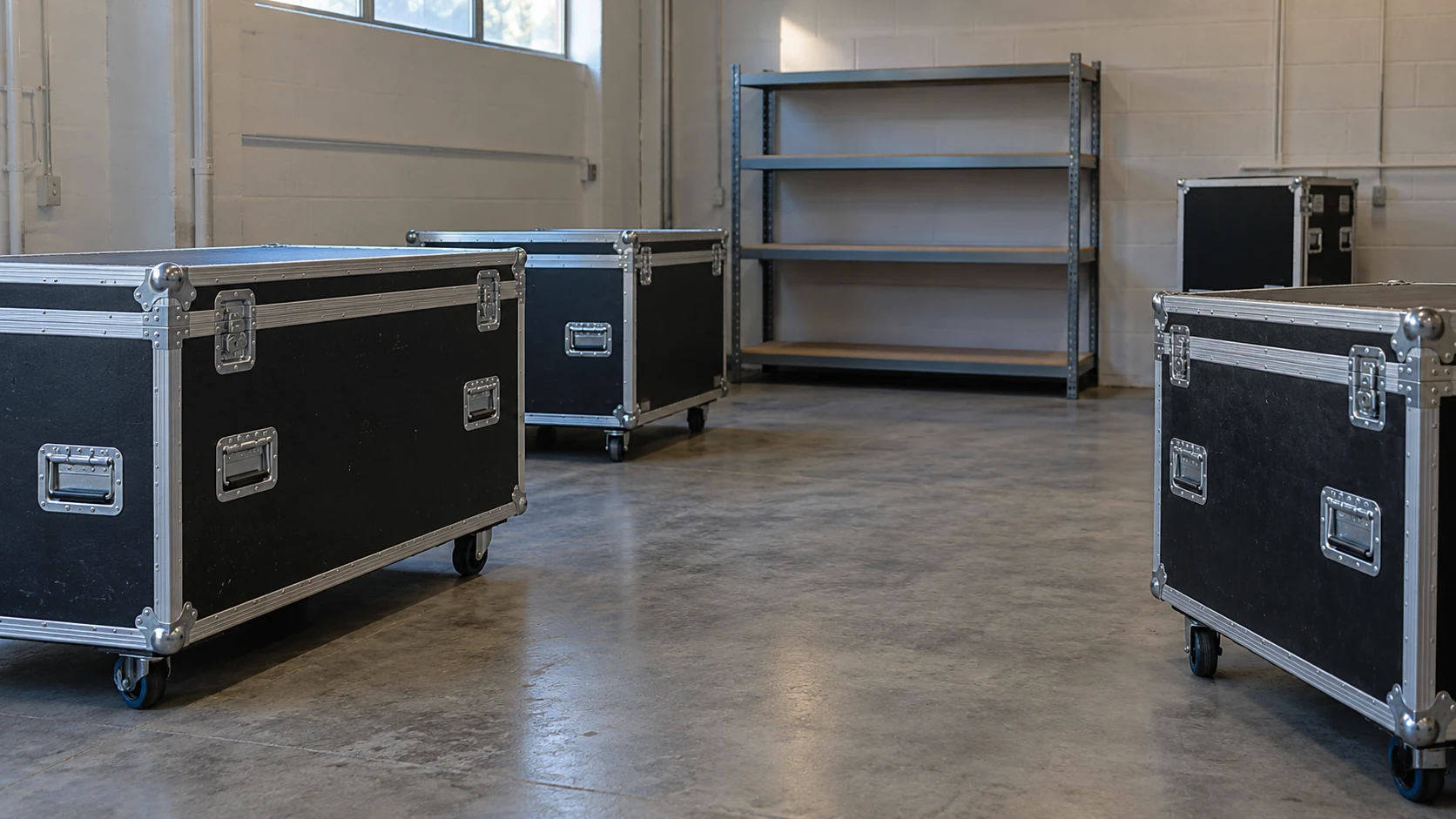
Storage is a physical requirement as well as a line in a spreadsheet. Check the actual packed volume, access route, handling equipment and storage conditions. The flight-case quantity guide helps connect a proposed cabinet inventory to its transport package.
Calculate a threshold, then test what changes it
For comparable recurring events, a simple undiscounted comparison is:
Ownership total = initial purchase + fixed costs for the period + event count × owned deployment cost − assumed resale proceeds.
Rental total = event count × equivalent rental cost per event.
If equivalent rental cost exceeds owned deployment cost, the arithmetic crossover is the net fixed ownership amount divided by that per-event difference. The net fixed amount is purchase plus period-wide fixed costs, less any resale assumption. If the difference is zero or negative, this simple model has no usage-driven crossover that favors ownership.
An illustrative three-year comparison
The following numbers are invented solely to show the calculation. They are not Mirun prices, rental-market averages or a forecast.
Assume a complete purchase and three years of fixed ownership costs total USD 90,000. Each owned deployment costs USD 4,500. An equivalent rental package costs USD 10,000 per event. Assume no resale proceeds, constant costs and the same service scope.
The crossover is USD 90,000 ÷ (USD 10,000 − USD 4,500), or approximately 16.4 events across the three-year period. On these assumptions, ownership first becomes cheaper at the seventeenth comparable event.
| Comparable events in three years | Rental total | Ownership total |
|---|---|---|
| 12 | USD 120,000 | USD 144,000 |
| 18 | USD 180,000 | USD 171,000 |
| 24 | USD 240,000 | USD 198,000 |
The eighteen-event case has only USD 9,000 of headroom. An extra owned deployment cost of USD 500 per event would consume that difference. A proposal that appears attractive at the expected workload can therefore change when crew or freight assumptions change.
Run a downside case with fewer confirmed events, higher repair or transport costs and no resale credit. This basic comparison does not model financing, the time value of money or future cost changes; extend it with your finance team when those affect the decision. It also cannot approve a screen that fails the technical brief.
Consider a hybrid approach for uneven demand
A hybrid approach can mean owning a configuration for recurring indoor work while hiring a separate system for occasional outdoor or larger events. It can also mean owning equipment but contracting crew and transport for each deployment.
Keep the baseline and exceptional jobs separate in the budget. Do not make a rarely used maximum screen size determine the entire purchase simply because it appears once on the calendar.
Be precise about adding rented cabinets to an owned wall. Matching external dimensions is insufficient to establish mechanical, electrical, control or calibration compatibility. Obtain written compatibility evidence for the exact combination before relying on expansion. Hiring a complete separate wall may be a more workable option.
A hybrid plan also needs confirmed availability. Document who reserves the extra equipment, when the order must be placed and which substitutions are acceptable. A hoped-for rental supply is weaker evidence than a priced, deliverable proposal.
Use this decision table before requesting final quotes
| Your operating position | Starting choice | Condition that changes the answer |
|---|---|---|
| A few uncertain events with changing requirements | Rent a defined service package | A stable, comparable program becomes confirmed |
| Repeatable work with a suitable configuration and accountable support | Evaluate buying | The downside cost case or operating capacity fails |
| Stable core work plus occasional specialist jobs | Evaluate a hybrid approach | Compatibility or rental availability cannot be confirmed |
| Continuous use in one committed location | Compare a purchase with an equivalent long-term service arrangement | Site tenure, relocation or support requirements remain uncertain |
Treat these as starting choices. Reject an option that cannot meet the content, venue or delivery deadline before ranking the remaining proposals by cost.
For a potential purchase, reduce uncertainty with a representative demonstration or LED display sample evaluation. Use actual content and the proposed configuration. For rental, agree the corresponding equipment confirmation and pre-event review. A favorable ownership spreadsheet does not replace acceptance.
Make the decision traceable
Write a short decision record naming the selected model, confirmed workload, comparable scope, cost assumptions and responsible operator. Explain which change would reopen the decision, such as a lost event program, relocation or a requirement the owned equipment cannot serve.
If you decide to buy or rent an LED video wall on that basis, the choice becomes easier to defend and revisit. Buy when suitable repeat use and operating capacity support ownership. Rent when flexibility and a defined delivery service better fit the project. Use a hybrid arrangement when the core and exceptional workloads can be separated credibly.
For an equipment proposal, send Mirun Hailian your project brief with the event calendar, screen sizes, environment, viewing and camera requirements, destinations, setup windows, existing inventory, operating team and expected ownership period. Ask for an included-and-excluded supply scope. Obtain local rental and service proposals separately where needed so the comparison reflects the complete job.
Remaining buyer questions
Is there a universal number of events after which buying wins?
No. The threshold depends on comparable rental charges, purchase scope, fixed costs, deployment costs and the work one inventory can replace. Calculate it from current project quotations and test a lower-use scenario.
Can we buy the cabinets and hire the rest of the service?
Yes, if a provider agrees to handle the proposed inventory and responsibilities. Confirm configuration familiarity, crew, transport, spares, support and liability terms in the service proposal before relying on that arrangement.
Does owning a wall guarantee availability on event day?
Ownership gives control of the asset, but readiness still depends on condition, transport, crew, compatible replacements and overlapping bookings. Keep a dispatch and fallback plan for the required dates.
Need help choosing the right LED display?
Tell us your installation scene, screen size, pixel pitch target and timeline. Mirun Hailian can help match the right product configuration.