LED display black level is the luminance a screen produces when the content should look black. Buyers should not approve it from a contrast-ratio claim alone. Real contrast depends on the measured black and white levels, room light reflected by the LED surface, screen brightness, masks and louvers, calibration, processing, content, and viewing position.
The practical buying rule is to define the use condition first, then measure and visually approve near-black content under that condition. Record the test pattern, ambient lighting, brightness setting, meter position, configuration files, and photographs. This turns “good blacks” from a sales impression into repeatable acceptance evidence.
What does black level mean on an LED display?
Black level is the light measured or perceived from a display area commanded to show black. On a direct-view LED wall, the LEDs in that area may emit little or no intended image light, but the surface can still look gray. Ambient light may reflect from LED packages, masks, cabinet seams, protective coatings, or nearby finishes. Electrical and processing behavior can also leave a faint glow or unevenness at the lowest signal levels.
A darker measured black generally gives bright content more visual separation. Yet the useful result is not simply “the lowest number wins.” A black level measured in a dark laboratory may not predict a bright lobby, broadcast studio, retail window, or boardroom. The buyer needs a black level that remains visually credible in the operating environment without crushing shadow detail.
Is black level the same as contrast ratio?
No. Black level is one measured endpoint. Contrast ratio compares a brighter level with a darker level using a stated method. A ratio is meaningful only when the numerator, denominator, test pattern, ambient light, screen settings, and measurement geometry are known.
Two displays can carry the same quoted contrast ratio and look different in the room. One may reach the ratio with unusually high white luminance while its black surface still reflects visible room light. Another may have a darker module face and more controlled reflections but use a lower operating brightness. The viewer experiences the complete relationship among black, white, surrounding light, and content—not a brochure ratio in isolation.
| Term | What it describes | What the buyer should request |
|---|---|---|
| Black level | Luminance or visible appearance of a black image area | Measured value and photographs under the approved room and screen settings |
| On/off contrast | Ratio between separate full-white and full-black measurements | Exact patterns, timing, meter position, brightness setting, and ambient condition |
| Simultaneous contrast | Bright and dark areas measured within the same image | Pattern layout and a method that limits stray light from bright patches |
| Ambient contrast | Separation between bright and dark content with room or daylight present | Site lighting condition, reflection control, and intended viewing direction |
| Near-black detail | Ability to distinguish very dark tones above black | Dark ramps and real content viewed across the required brightness range |
Why can an LED wall look gray when it is off?
The module face is a physical object before it is a display. Its LED packages, black encapsulation, mask finish, louvers, screws, coatings, and gaps all reflect some incoming light. Light-colored ceilings, windows, spotlights, polished floors, or illuminated objects opposite the wall can lift the apparent black level even when the pixels are off.
That is why a photograph taken in a nearly dark showroom may overstate the site result. Ask suppliers to show the screen both powered off and displaying black under representative lighting. Inspect it from the center and important side positions. For a window-facing or outdoor installation, review the changing daylight direction rather than assuming one evening demonstration represents the full day.
Which product details influence perceived black?
Several design choices can change the appearance of dark content. A matte black mask may absorb more incident light than a glossy surface. Deeper or better-shaped louvers can reduce reflections from some directions, although they may also affect viewing angle. Dark LED packages and careful mechanical alignment can reduce visible bright points and seams. Protective coatings may improve durability while changing surface reflection, so the actual offered finish should be tested.
Electronics matter too. Driver behavior, current control, calibration, gamma, grayscale processing, receiving-card parameters, processor output, and brightness reduction can affect the first visible steps above black. A display can have a dark physical face yet lose shadow detail, show color tint in dark gray, or reveal module boundaries when dimmed. Buyers therefore need both optical inspection and low-gray content testing.
How should buyers test LED display black level?
Start with a written condition that another team can reproduce. Identify the room or daylight state, which lights are on, the screen brightness and white point, the processor and receiving-card configuration, the measurement distance and angle, and whether the reading is taken at the center or across several positions. Allow the system to reach a stable operating condition before recording the result.
- Inspect the unpowered surface. Look for reflections, mask color, coating differences, cabinet seams, damaged louvers, and bright hardware.
- Display full black. Measure at agreed positions and check for glow, colored pixels, uneven modules, edge leakage, or processing that changes after a delay.
- Display near-black steps. Confirm that the darkest useful tones remain distinct rather than merging into black or shifting color.
- Use simultaneous bright and dark content. Look for reflected spill, flare, local haze, and loss of dark detail beside highlights.
- Repeat at operating brightness levels. A setting approved at maximum output may behave differently during comfortable indoor operation.
- Restore the saved configuration. Repeat key observations after a restart so acceptance does not depend on an undocumented temporary adjustment.
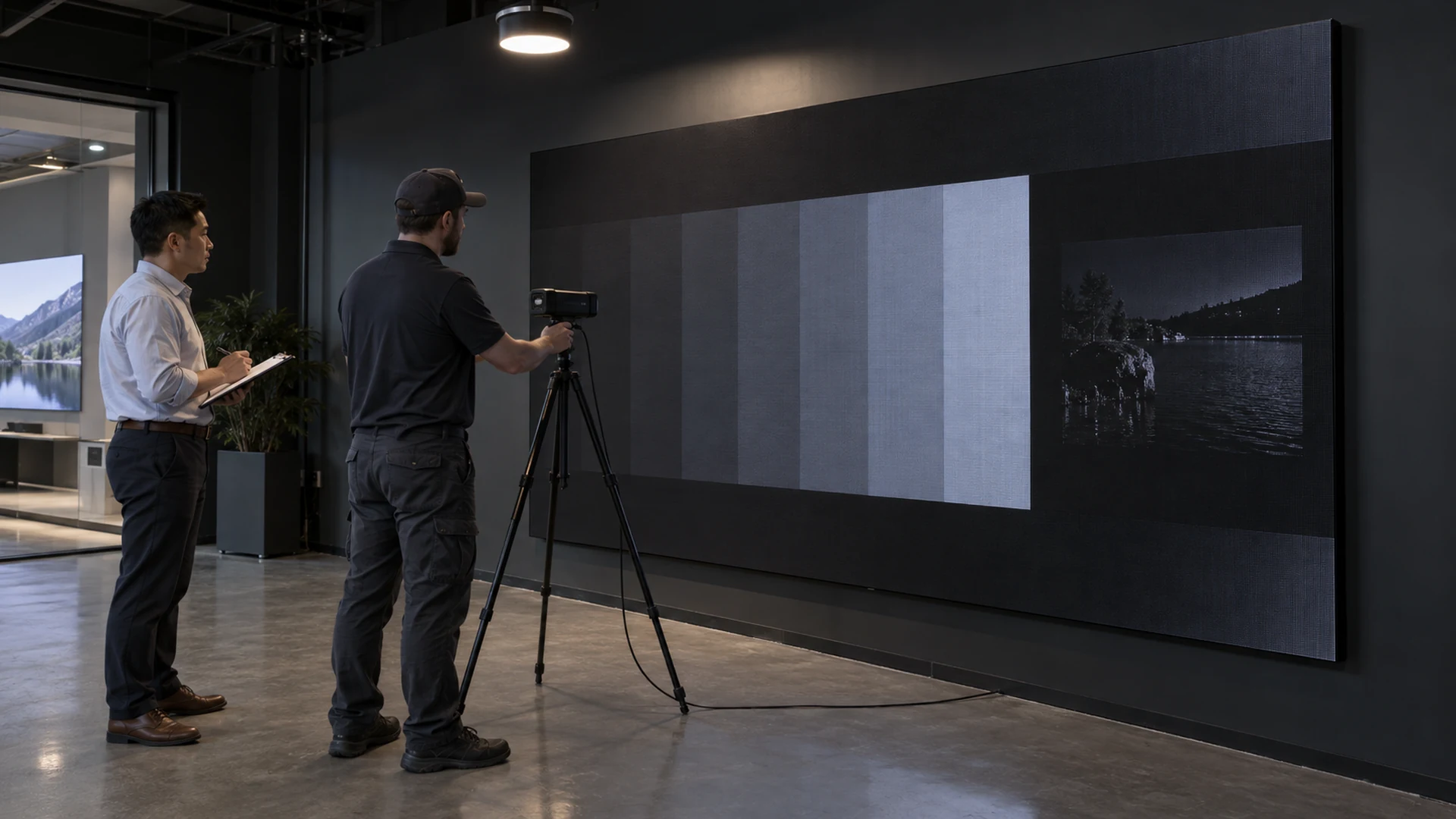
Use the buyer’s real content as a final check. Night scenes, dark clothing, product photography, shadowed faces, subtitles over black, and corporate backgrounds can reveal issues that a simple full-black frame cannot. If the wall will operate at reduced brightness, follow the same sequence there. The separate guide to LED display low-brightness grayscale explains how to evaluate tonal steps, color stability, and module consistency in those conditions.
What test conditions must be written down?
A measurement without conditions is hard to compare and harder to reproduce. The acceptance sheet should identify the display model and batch, module and mask version, processor, sending and receiving hardware, firmware, calibration file, brightness setting, white point, gamma or image mode, test-pattern source, meter model, meter position, ambient-light state, date, and person responsible.
Photographs are useful evidence only when exposure is controlled. A phone can automatically brighten a dark scene or deepen blacks, making two screens look more different—or more similar—than they are. Keep the camera position and exposure consistent, include a wider room view, and treat photographs as supporting evidence rather than a substitute for the approved measurement and in-person review.
How should indoor and outdoor projects differ?
Indoor fine-pitch projects often need convincing blacks at comfortable brightness, close viewing distance, and controlled but not completely dark lighting. Test presentation backgrounds, dark interface elements, video conferencing, and any camera use. Reflections from meeting-room tables, ceiling lights, or glass partitions can be more important than maximum luminance. Buyers planning this application can compare project options on the fine-pitch LED display page.
Outdoor screens face much stronger and more variable ambient light. Deep-looking black at night does not guarantee usable daytime contrast, while extreme brightness alone does not eliminate surface reflections. Evaluate screen orientation, sun path, nearby façades, louvers, automatic brightness behavior, and viewing direction together. The brightness control should protect dark-scene readability at night without forcing one setting across every condition. See the automatic brightness control buyer guide for the control and responsibility questions to include.
Can HDR compensate for a weak black level?
Not by itself. HDR processing can manage a wider creative range and make highlights more expressive, but the visible result still depends on the display’s dark floor, peak output, grayscale precision, tone mapping, content mastering, and room light. If ambient reflection makes black look gray, an HDR label does not remove that reflected light.
For HDR or premium presentation projects, test real dark-and-bright scenes through the proposed playback chain. Confirm that shadow detail is visible, highlights are controlled, color remains neutral in dark tones, and settings survive a power cycle. The LED display HDR and wide color gamut guide covers the content, processing, calibration, and evidence that should accompany the display claim.
What belongs in the purchase specification?
A strong specification describes the required result and how it will be judged. It does not rely on one contrast figure copied from a data sheet.
- Project environment, important viewing positions, content types, and operating brightness range
- Agreed definition and method for black-level and contrast measurements
- Ambient-light conditions for factory test, site test, or both
- Test patterns, near-black content, real project content, and acceptance sequence
- Module, LED package, mask, coating, driver, and control-system configuration used for approval
- Required evidence: measurement record, wide and close photographs, settings, and exported files
- Rules for component, mask, coating, firmware, calibration, or processor changes after approval
- Responsible parties for room lighting, display configuration, testing, sign-off, and later restoration
The manufacturer should document the supplied hardware and stable configuration. The integrator should control the signal path, calibration files, and saved parameters. The lighting or interior team should deliver the agreed ambient condition. The buyer or consultant should provide test content and approve the evidence. When these responsibilities are visible, a black-level issue is less likely to become an argument between unrelated scopes during commissioning.
What evidence should be saved after acceptance?
Save the signed test sheet, original meter readings, photographs with exposure notes, test patterns, processor preset, receiving-card parameters, calibration data, firmware references, and a list of installed module and mask revisions. Store the approved content files and identify the lighting scene used during the test. A short restoration procedure should explain how a technician returns the wall to the approved state after service.
This evidence is valuable when a spare module is installed, a processor is replaced, a firmware update is proposed, or room lighting changes. It provides a baseline for deciding whether the screen has changed or the environment has. It also gives future service teams a practical target instead of asking them to recreate a visual preference from memory.
Frequently asked questions
What is a good LED display black level?
A good black level is dark, uniform, and repeatable enough for the project’s lighting, content, viewing positions, and brightness range while preserving visible near-black detail. There is no universal number that covers every room, outdoor orientation, meter method, and application.
Should black level be tested with the screen off?
Yes, but that is only one part of the test. The unpowered surface reveals reflected light and physical finish. Also test commanded black, near-black gradients, and simultaneous bright-and-dark content at the actual operating settings.
Why do dark scenes show cabinet or module boundaries?
Possible causes include differences in masks, coatings, module batches, calibration, current control, temperature, mechanical alignment, or reflected light. Record whether the lines remain visible when powered off, on full black, and on near-black gray; that comparison helps separate physical reflection from emitted-light behavior.
What should I send when requesting a black-level test?
Send the installation environment, screen size, viewing distance and angles, room-lighting description, content examples, expected brightness range, camera use, processor source, and desired acceptance evidence. Contact Mirun’s project team with those inputs to discuss a test condition that suppliers can quote and repeat.
Need help choosing the right LED display?
Tell us your installation scene, screen size, pixel pitch target and timeline. Mirun Hailian can help match the right product configuration.