A storefront screen has two jobs that can compete: make the campaign visible and keep the shop inviting to look into. Choose a transparent LED screen when seeing merchandise or the interior through the display is part of the brief and the actual campaign remains legible in the proposed location. Choose an opaque LED screen when a continuous image background matters more than the view through its footprint. If both goals are essential, test a smaller opaque display beside clear glazing before assuming the whole window needs a transparent screen.
This transparent vs opaque LED screen comparison is for retail buyers and fit-out teams choosing direct-view LED signage behind storefront glass. “Opaque” means a conventional display face that blocks the view behind it. Transparent LED cabinets, mesh and film are different constructions within the see-through category; transparent OLED and LCD products require a separate comparison.
Start with what the window must still do
Write down the result that would make the purchase worthwhile. Is the screen attracting attention from across the street, explaining one product to passing pedestrians, or replacing printed campaign graphics? Also name what must remain visible: a display table, an entrance, the depth of the showroom or a particular merchandise arrangement.
Draw these sightlines on a photograph taken from the customer’s approach. A screen can leave plenty of glass uncovered while blocking the exact product the shop needs to show. Conversely, a transparent installation across the whole bay can leave a recognizable interior while introducing visible hardware across every important view. Area alone does not settle that difference.
Check both directions. The customer outside sees the advertising face; staff and customers inside may see the rear of the assembly, its supports and its cabling. An attractive front demonstration does not describe that interior experience. Agree on the acceptable appearance during playback, between campaigns and when the display is off.
Use the transparent LED display overview to identify candidate construction types after defining those requirements. Ask the supplier to show the complete assembly in elevation, including frames and control enclosures. Treat a transparency percentage as one input to that layout, not as the buying decision.
Which option belongs on the shortlist?
| Storefront priority | First option to test | Condition that can change the choice |
|---|---|---|
| Preserve a view of merchandise behind the screen | Transparent LED | The displayed campaign or visible hardware obscures the merchandise |
| Give photographs and essential text a continuous background | Opaque LED | Its footprint blocks an important sightline or takes too much window space |
| Keep most glazing clear while showing one focused promotion | Smaller opaque screen in part of the bay | The required message becomes too small from the viewing route |
| Cover a broad glass area with sparse animated graphics | Transparent LED | Daylight, background clutter or the nearest viewer makes the content ineffective |
The table sets a testing order. It does not establish a universal winner, a minimum brightness or an acceptable viewing distance. The strongest proposal is the one that passes the agreed communication task in the actual window and includes the work needed to operate it.
What does transparency give you—and what does it not?
A transparent LED display allows some view through its construction while emitting an image. The effect depends on the hardware, the background, the viewing direction and the content being shown. A transparent label does not mean the installed screen disappears, and a dark area in a video should not be assumed to create the same solid dark background as an opaque display.
Planar’s custom LED overview identifies transparent LED as an option for store windows where merchandise remains visible behind the display. That supports the application principle, not a claim that every transparent product has the same clarity or suitability. The quoted model and complete mounting arrangement still need review.
Ask how the supplier defines its transparency figure and what is included in the measurement. A module figure may not describe the framing, mullions, cables or other parts that occupy the finished opening. Optical transmission, geometric open area and the shopper’s ability to recognize merchandise are also different questions.
For a closer measurement discussion, use the transparent LED transparency guide. For the purchasing decision, add a simple viewing task: can the intended customer identify the selected merchandise through the proposed screen while the approved campaign plays? Record the viewpoint, lighting and content used.
Can the campaign tolerate a visible background?
Transparent screens deserve a test with content designed for that surface. A sparse product outline, a large graphic or a short message may allow the interior to remain part of the composition. A dense photograph, small price list or detailed specification panel can place different demands on separation from the background.
Do not approve the display using only a supplier’s most striking animation. Bring a normal campaign and the least forgiving file the store expects to use. Include small essential wording, a product image with darker areas and a promotion that must remain understandable while customers are moving past. Check meaning as well as visual impact.
A conventional opaque LED face separates the displayed image from objects behind it. That can make a continuous composition easier to control, but it does not guarantee readable text or accurate colors. Screen size, native pixel count, processing, ambient light and content design still matter. An unsuitable small screen remains unsuitable when its background is opaque.
For that route, the indoor LED display overview helps frame a product discussion. Confirm that the particular model is appropriate for the window’s conditions. Installing a product indoors does not, by itself, resolve direct sunlight, reflections or the temperature around a glass-facing installation.
Would partial window coverage solve the conflict?
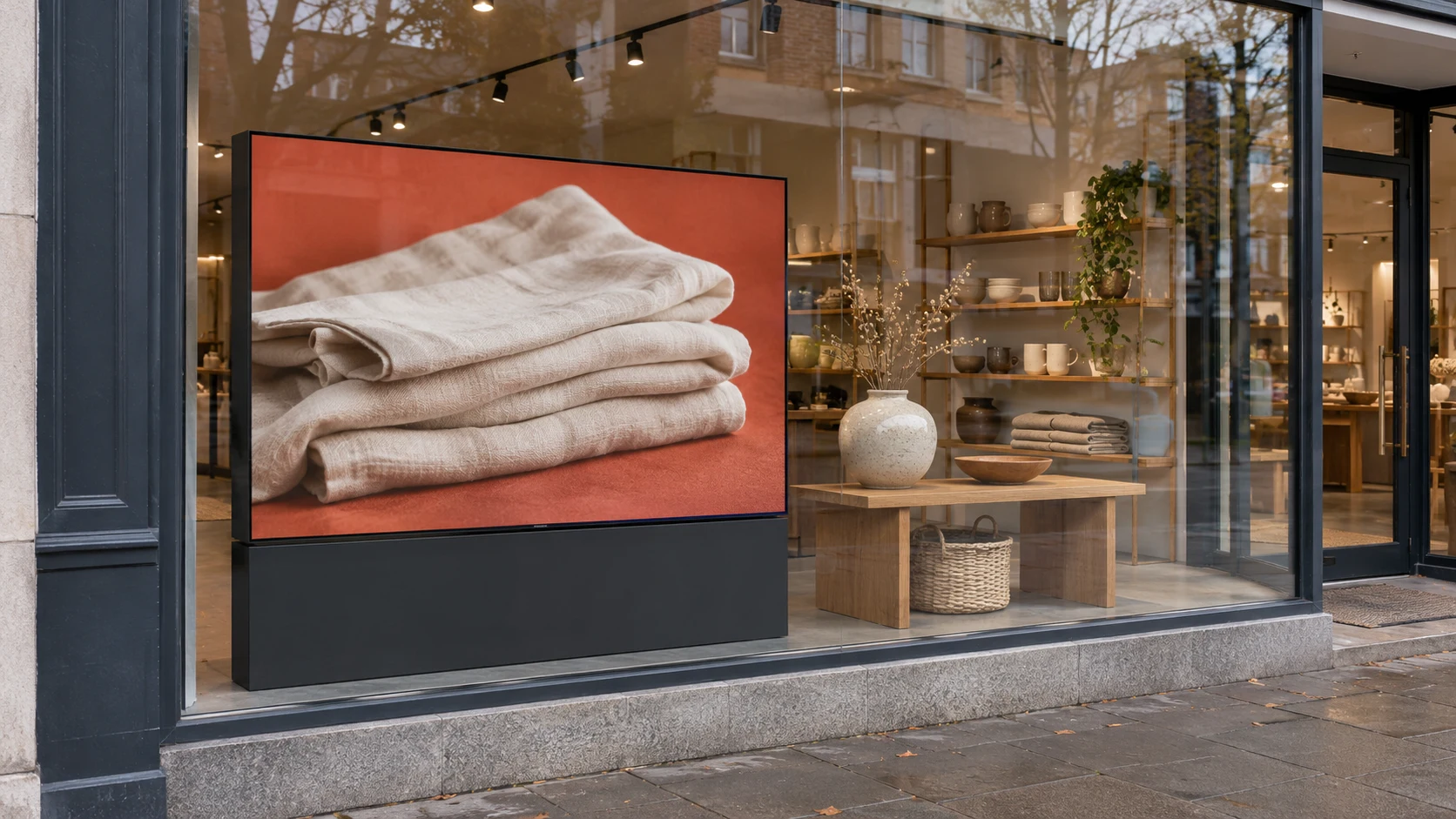
Consider a smaller opaque screen before choosing between a completely open window and a completely covered one. Positioning the advertising surface beside a clear merchandise view can preserve both functions. It may also require a different creative layout and a closer review of where pedestrians first notice the campaign.
Here is a geometric planning example, not a Mirun specification or a daylight calculation. Assume a usable glazed opening is 3.2 m wide and 2.4 m high: 3.2 × 2.4 = 7.68 m². An opaque display with a 1.6 × 0.9 m image occupies 1.44 m², or 18.75% of that opening. Before allowing for its supports and other obstructions, 6.24 m² lies outside the image footprint.
That result says how much projected area is covered by the image. It does not prove that 81.25% of the original daylight remains, that every sightline stays open, or that the smaller campaign is readable. A central screen could still hide the most important fixture. A side position could preserve the fixture but move the message away from the main approach.
Do not compare that 18.75% coverage directly with a transparent product’s advertised percentage. They describe different things. Compare dimensioned layouts from the same customer viewpoints, then test the campaign at its proposed physical size. Use the result to decide whether the project needs a transparent surface, a smaller opaque surface or a revised merchandising plan.
What should the daytime trial include?
Test the times that matter to the store. A display that looks convincing after sunset may face different reflections and background brightness during trading hours. Record the window orientation, shading, surrounding reflective surfaces, interior lighting and the conditions during the trial. A short demonstration cannot represent an entire year of sunlight conditions.
Show both candidates from the nearest normal viewing position and the main approach route. Use the same communication objective, with a suitable creative version for each screen. An identical file can be an unfair comparison when one candidate needs a different layout, but both versions should convey the same essential information.
Ask viewers to identify the promotion and read its essential detail without being told what it says. Also ask them to locate the merchandise that should remain visible behind or beside the installation. Photograph the setup for documentation, while recognizing that a camera’s exposure and focus do not replace direct viewing.
Include a lower-light setting and the agreed method for adjusting brightness. Have the supplier document the tested operating settings and model limits. Let the installation team assess the local environment and thermal provisions. Avoid solving a failed demonstration simply by demanding a higher headline brightness figure without considering the rest of the system.
Compare installation scope before comparing price
Request a complete usable installation for each option. Transparent does not automatically mean lighter, cooler, simpler to fit or cheaper to maintain. Those outcomes depend on the chosen construction and location. Likewise, an opaque wall quote may exclude the frame, finishing and site work that make the display usable.
For a transparent proposal, identify what supports the display, how visible hardware aligns with the glazing, where the controller and power equipment sit, and how someone reaches a failed part. For film products, obtain model-specific installation and removal instructions. A claim that a film attaches to glass does not establish compatibility with every glazing treatment or permission to use it on that site.
For an opaque proposal, identify the full assembly depth, its rear appearance, mounting or base arrangement, cable route and service clearance. Check the effect on cleaning and the merchandising space behind it. A neat front rendering can hide an awkward interior obstruction.
The transparent screen site-survey checklist can help collect the window interfaces before quotation. Assign the building, glazing and mounting review to the relevant qualified parties, and identify any landlord approval needed. The display supplier’s product specification should not substitute for approval of the completed installation.
Approve an operating plan, not just a sample image
Ask who will create, approve and publish the campaign. Confirm the included player, software, accounts and any recurring charges. A transparent screen that needs different artwork can create ongoing production work; include that work in the comparison instead of treating the first demonstration file as a permanent solution.
Give the creative team the native canvas, orientation, usable content area and export requirements. Save an approved sample file and the corresponding settings in the content handover package. If the store changes its window arrangement, retest the important campaign against the new background.
Before placing the order, require three practical demonstrations: normal campaign playback, a routine content update, and the agreed behavior after a restart or interrupted input. Record the service route, available replacement parts and who restores the display when the usual operator is absent. Agree these tasks for the quoted system rather than assuming them from its category.
Choose the transparent or opaque LED screen that preserves the window’s intended job and passes the content test under representative conditions. When neither option passes, change the screen position, campaign layout or project scope before committing. A smaller, properly positioned installation may serve the store better than covering the largest possible glass area.
To compare options with Mirun, send a storefront display brief containing the window dimensions, photos from outside and inside, customer approach, merchandise that must remain visible, representative campaign files, daylight conditions, mounting constraints, update workflow, budget scope and installation location. Request a dimensioned layout, a clear list of included and excluded work, and a demonstration plan for each shortlisted option.
Need help choosing the right LED display?
Tell us your installation scene, screen size, pixel pitch target and timeline. Mirun Hailian can help match the right product configuration.