A roadside LED billboard—a commercial LED billboard built for outdoor advertising—is not specified well by screen size and peak brightness alone. Its value depends on the site, approach direction, viewing time, local approvals and how the content is controlled. A technically capable display can still be the wrong purchase if it sits where drivers have little time to see it, competes with a traffic decision, or cannot meet the site’s lighting limits. A digital billboard that works in a pedestrian plaza may need a different content, viewing and approval plan beside a road.
Before ordering a roadside LED billboard, confirm the sign’s permitted use and location, map the real approach views, agree a simple content policy, and verify day-to-night brightness behavior at the installed position. Treat the display, structure, player, approvals and maintenance access as one project scope. The brightness and wind values on a cabinet datasheet do not approve a site.
This guide is for commercial advertising displays. A commercial billboard and an official changeable traffic message sign may both use LEDs, but they serve different purposes and can be governed by different rules.
Is this a commercial billboard or a traffic control sign?
Set the sign’s purpose before selecting hardware. Commercial roadside media advertises a business, product or service. A transportation agency’s dynamic message sign communicates traffic operations, regulations, warnings or guidance. Do not assume that a commercial screen can also be used as a public traffic message board because the pixels can show text.
In the United States, the current Federal Highway Administration (FHWA) MUTCD, 11th Edition with Revision 1 covers official traffic-control devices. Its portable changeable-message-sign provisions address traffic operations, regulations, warnings and guidance—not commercial advertising. Do not treat rules for an official traffic sign as a universal permit for a commercial display. Separately, 23 U.S.C. §131 governs outdoor-advertising control in specified federal highway contexts; sign categories and size, lighting and spacing requirements depend on the statute and state or local implementation. Start with the relevant road authority and planning or zoning office for the actual site.
Record the proposed sign use, owner, land parcel, road class and approving authorities in the project brief. Confirm that the permits cover an electronic display and its intended operating schedule, not simply an older static sign. If the site requires a separate structural, electrical or road-safety review, identify who submits each package and receives approval.
Study the approach before choosing the display
Collect a site plan and photographs taken from each relevant approach. Mark the road direction, likely viewing distance, sign orientation, bends, slopes, junctions, exits, trees and other signs. Note whether a driver must read the message while merging, choosing a lane or responding to another instruction. This map helps the project team and authority discuss the same location.
A face that looks clear from the property boundary may appear oblique or partly hidden from the road. Roadside lighting, vehicle headlamps, wet surfaces and surrounding signs also change what the observer sees. Where pedestrian or local-street viewing matters, record those positions separately from the main-road view.
Use the site’s actual viewing distances and content to choose pixel pitch and screen dimensions. A long-range display may not benefit from the same pixel density as a pedestrian-facing sign. A closer, larger panel also does not make a complex message safe or readable at speed. Ask for sample creative at the proposed pixel map and assess it from the intended viewpoints.
Design content for a brief glance
Drivers have limited time to look away from the road. Use a short message with a clear visual hierarchy and one main idea. Put the brand or offer where it can be understood quickly. Avoid small secondary copy, dense contact details, QR codes intended for scanning while moving, and layouts that ask a viewer to read a sequence.
Agree the transition behavior in advance. A static creative change, fade, animation, flashing effect or video loop can be treated differently by local rules or the approving authority. Do not copy creative conventions from a digital display in a mall and assume they will be allowed beside a road. Send representative frames and transition examples with the approval submission if the rules require them.
Keep the content policy in writing: permitted creative formats, update approval, who may schedule a campaign and how a rejected asset is handled. If the display is blanked or switched to a fallback after a fault, define an approved state that does not resemble an official traffic sign. Public safety notices belong on the display only when the operator and relevant authority have authorized that use.
Specify brightness control across the whole day
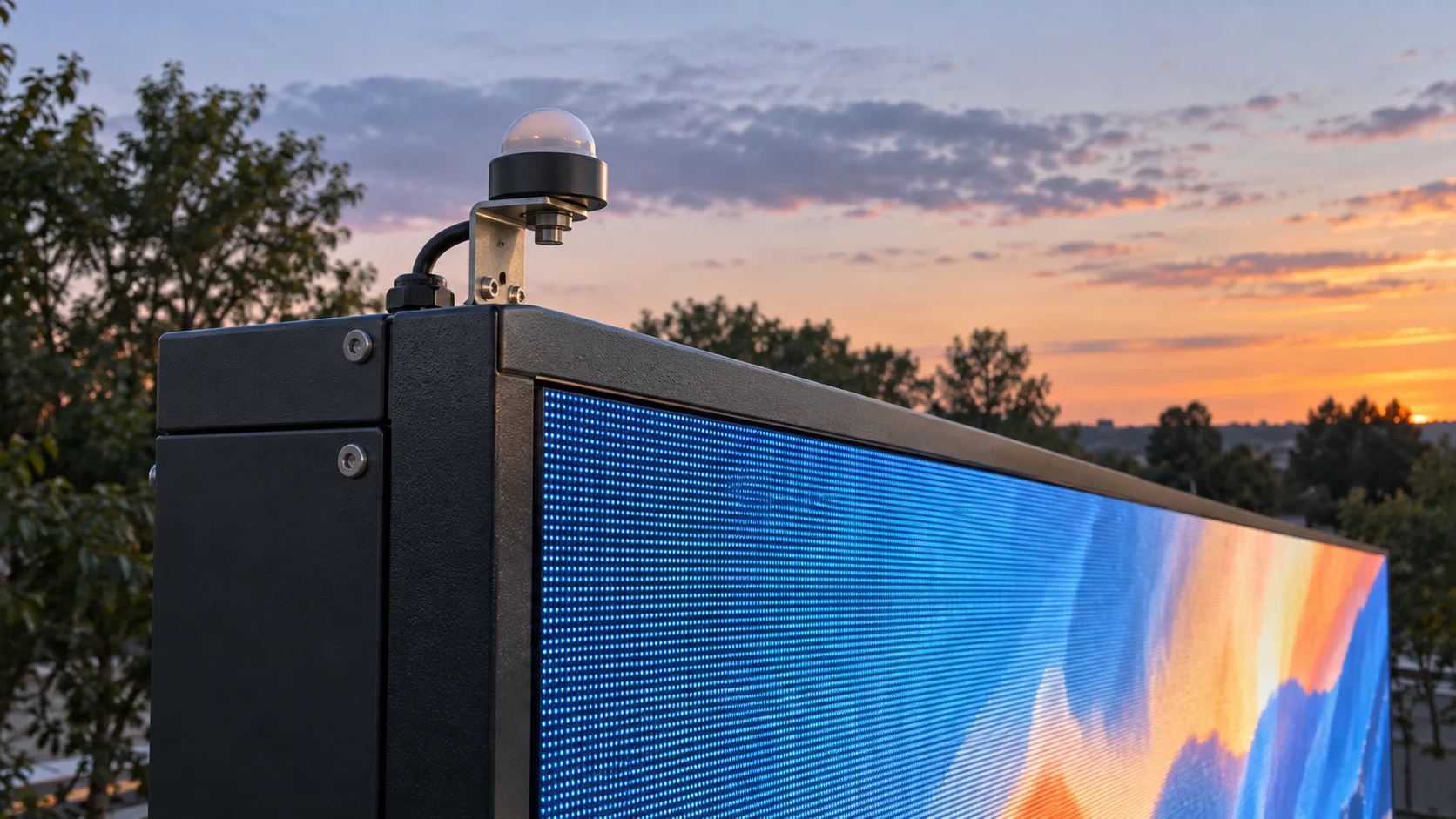
“High brightness” describes a capability, not a nighttime operating target. Ask the supplier for the available control range, ambient-light sensor arrangement, automatic response and any manual limits. Identify who sets the operating schedule and who may override it. Match these details to the applicable permit conditions and nearby environment.
Review brightness at the intended day and night conditions from the road approach, not just from directly in front of the panel. Include dawn, dusk and changing ambient light in the commissioning plan where they matter. Check that the sensor receives representative light and is not routinely shaded, pointed toward the display, or affected by unrelated lighting.
Record the settings used for approval and who can change them afterward. A commissioning photo at noon cannot confirm a nighttime setting. If the operating schedule, sensor, display orientation or permitted luminance changes, determine whether a fresh review is required. See the related LED display brightness-control guide for questions to include in the system specification.
Coordinate the structure, enclosure and service plan
A roadside screen places loads on a pole, frame, building or foundation. A qualified local structural professional should assess the complete proposed assembly using the applicable site requirements. Provide the display dimensions, cabinet arrangement, mounting details, weight and product wind data for that review. Product data alone is not an approved foundation or engineered structure.
Confirm that the selected outdoor cabinet configuration is suitable for the site exposure and that cable entries, connectors and service openings are covered in the agreed installation. Outdoor enclosure ratings describe defined equipment conditions. They do not automatically rate the foundation, support steel, field wiring or completed sign. The wind-load data guide and IP-rating guide can help assemble questions for the respective technical reviewers.
Maintenance access affects pole placement, cabinet service design, traffic management and operating cost. Decide whether the display is front-service or rear-service, how technicians reach it, and whether work requires a lane or sidewalk closure. Keep the access plan within the property and road approvals. Mirun’s outdoor LED display options cover cabinet configurations; a project-specific site and structure review is still needed.
Set acceptance tests that match the permitted use
Acceptance should verify the complete installed system, not just a cabinet sample. With the display at its approved orientation, test representative content from each agreed approach. Confirm that the player sends the intended canvas, scaling and timing, and that each content transition matches the submitted creative policy.
Demonstrate automatic and manual brightness controls with the responsible operator present. Record the sensor location, schedule, configured limits and override owner. Verify network access, authorized publishing accounts and the process for removing an incorrect campaign. Do not call an ordinary display fault “traffic message redundancy”; the roadside advertising system needs its own approved operational and fault response.
Check service access, mounting interfaces and the installed sign’s visible face. If content is delivered through a remote CMS, test the publishing path and a safe fallback. For signal-path recovery questions, use the separate LED display signal-loss guide. Keep signed approvals, as-built drawings, controller settings and the test record with the site owner.
Compare quotations by responsibility
Roadside quotes can include very different work. Compare the display, player and commissioning separately from land rights, permitting, utility connection, structure design, foundation, traffic management and installation. Ask whether site survey, engineering inputs, local submissions, brightness configuration and operator training are included, excluded or assigned to another party.
Use a responsibility matrix and name one lead for each approval. Identify who owns the display, the structure and the content account. Include delivery access, crane or lift planning, maintenance method, spare modules and response to site changes. A lower hardware price does not answer which party has budgeted for these items.
| RFQ item | What to provide | What to confirm in the offer |
|---|---|---|
| Site and road context | Parcel, road class, approach photos and viewing positions | Survey scope and permit owner |
| Display requirement | Face dimensions, orientation, pitch intent and example creative | Cabinet layout and player output |
| Lighting plan | Day/night conditions and applicable approval limits | Sensor, control range, schedule and commissioning proof |
| Structure and access | Proposed support, location and service approach | Engineering responsibility and installation exclusions |
| Content operations | Campaign roles, update frequency and transition examples | CMS scope, permissions and approved fault state |
What should buyers send for a useful quote?
A roadside LED billboard works when the site, approvals, display and operating plan agree. Begin with the authority and viewing context, then select the configuration. Confirm day and night behavior on site and retain the settings and approval evidence for the operator.
For a project discussion with Mirun, send the billboard brief: country and road authority, parcel or site plan, approach photographs, screen dimensions, viewing distances, target content, operating hours, planned structure and project timeline. Ask which display and commissioning items are included and which local professionals or authorities must complete the remaining reviews.
Roadside billboard questions buyers ask
Can an LED advertising billboard display official traffic messages?
Do not assume it can. Commercial advertising and government traffic control signs have different functions and may follow different rules. Ask the relevant transportation authority whether any public-message use is permitted and who must approve and control it.
Is a high-brightness outdoor display automatically suitable beside a road?
No. Confirm local lighting limits, viewing conditions, automatic controls, sensor placement and the approved operating schedule. Demonstrate the configured result at the site during relevant day and night conditions.
Does a billboard product approval cover its pole and foundation?
Not by itself. The complete support and foundation must be reviewed for the actual location by the responsible qualified professional under local requirements. Supply the display’s configuration and mounting data as inputs to that review.
Need help choosing the right LED display?
Tell us your installation scene, screen size, pixel pitch target and timeline. Mirun Hailian can help match the right product configuration.